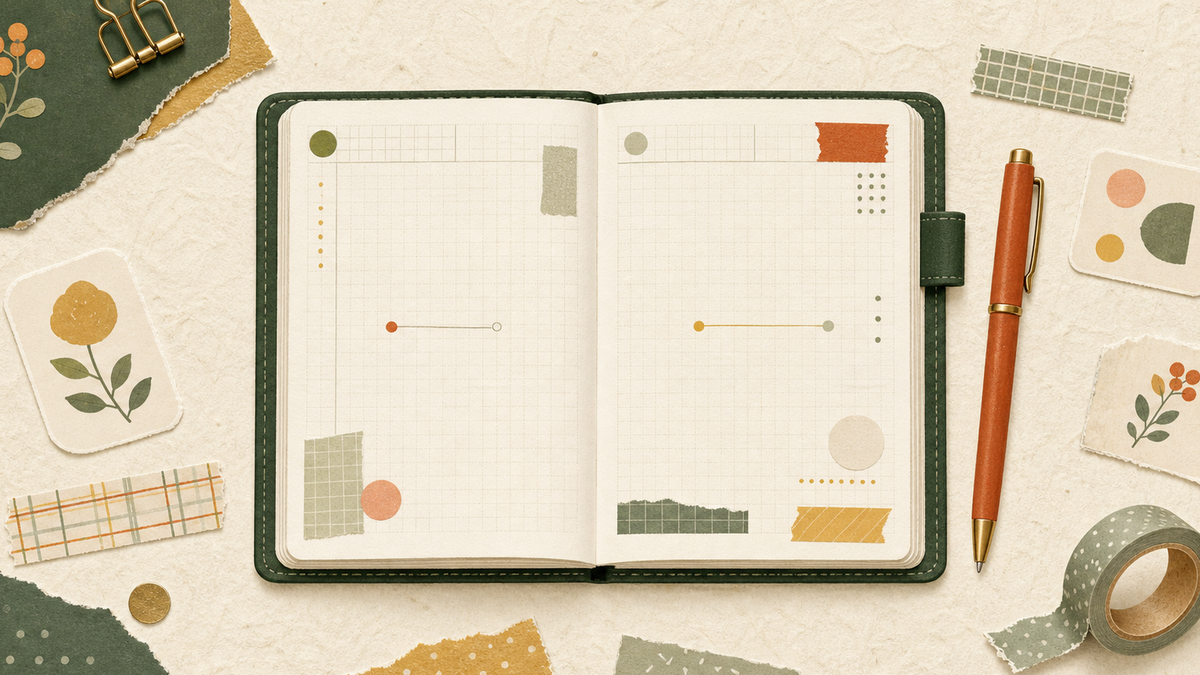
A Hobonichi Techo isn’t really a planner in the Western sense — it’s a full page per day, in a notebook-grade paper built to handle fountain pens, watercolor, and stickers without bleeding through. That’s the entire premise, and it’s also why it either clicks immediately or feels pointless: if you want a compact daily planner for appointments, a full page per day is overkill. If you want a daily journal with enough room to actually think on the page, it’s built exactly for that.
What makes the paper different
Most planner paper is thin and optimized for cost, which is fine until you use a fountain pen or add a sticker and everything ghosts through to the next page. Hobonichi’s signature Tomoe River paper is thin but genuinely bleed-resistant, which is the detail that turns a loyal following into an evangelical one — it’s the reason people who’d never call themselves “stationery people” end up recommending it. It’s also why a Hobonichi costs more than a standard planner: the paper is the product, not an afterthought.
A6 size, and why that’s the actual design choice
The standard Hobonichi Techo comes in A6 — notably small for a full daily-page format. This isn’t a limitation so much as the design intent: it’s meant to travel in a bag or a jacket pocket, not sit on a desk. If you’re picturing something closer to a desk planner, the Hobonichi Techo 2026 Original Book (A6, English, Daily) is smaller in person than most first-time buyers expect — worth knowing before it arrives, not after.
Who it’s actually for
- Journalers who want structure without a blank page — the dated, gridded page gives you a starting point without demanding a fully open-ended journal habit
- Fountain pen users — this is close to the only planner paper that reliably handles wet fountain pen ink without show-through
- People who’ve bounced off planners before — if a typical week-per-page planner has always felt too cramped to actually use, the full-page format solves that directly
Who it’s probably not for
- Anyone wanting a primarily scheduling-focused tool — a full page per day is a lot of real estate for “3pm dentist,” and a simpler weekly planner will serve that need better and cheaper
- Anyone who wants to carry a larger notebook alongside a planner — the A6 size is genuinely small, and it’s not the right home for extensive daily writing if you already keep a separate journal
Getting started without overcommitting
The Hobonichi Techo Original (the one described above) is the standard entry point, and buying just that — rather than the full ecosystem of covers, pen loops, and stickers the brand also sells — is a reasonable way to find out if the format works for you before spending more. The cover and accessories are genuinely optional; the notebook itself is what determines whether this becomes a daily habit.
FAQ: Hobonichi Techo
Is Hobonichi Techo worth the price compared to a regular planner? If you use a fountain pen, add stickers, or write more than a few lines a day, yes — the paper quality solves a real problem cheaper planners have. If you just need to track appointments, a standard planner will do the job for less.
What size should a first-time buyer get? The standard A6 is the default recommendation — it’s the size the format was designed around. Larger sizes exist but lose some of the “fits in a pocket” portability that’s part of the appeal.
Does Hobonichi Techo paper really not bleed with fountain pens? It handles fountain pen ink dramatically better than typical planner or notebook paper, though “no bleed at all” depends on the specific ink and nib. It’s a real, measurable improvement over standard paper, not just marketing language.
Do I need to buy the official Hobonichi cover? No — the notebook itself is a complete, usable product on its own. The cover is a later purchase worth making only once you know you’ll keep using the format.