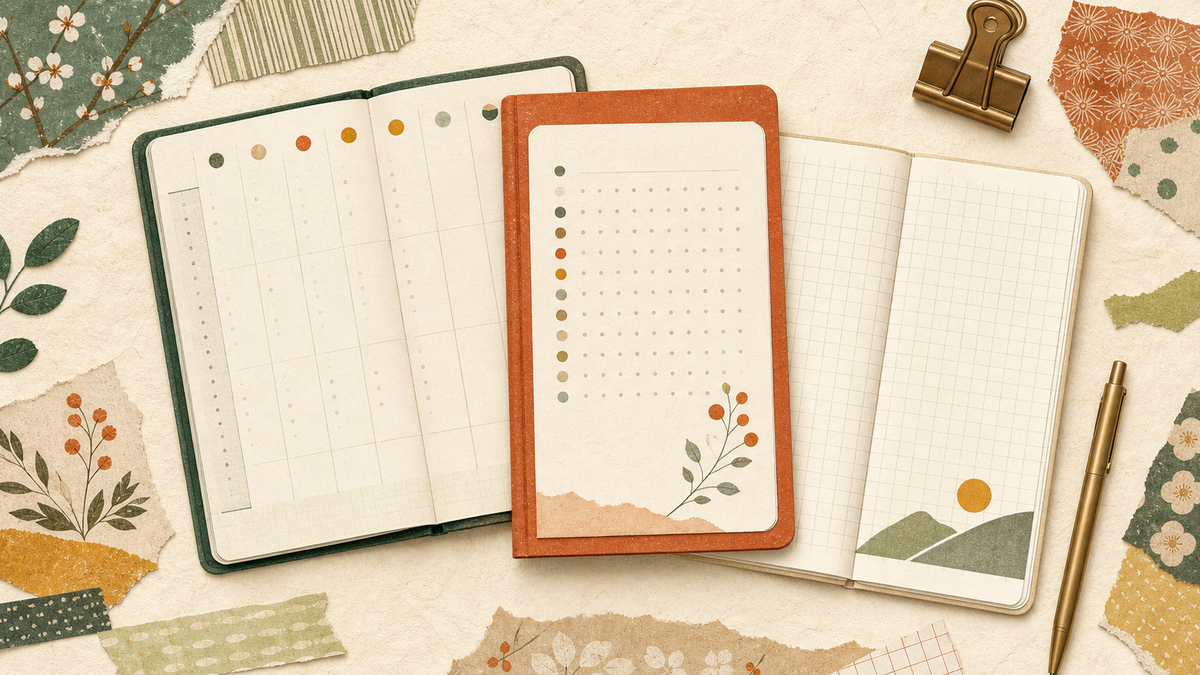
Jibun Techo (literally “myself planner”) isn’t a single notebook — it’s a three-booklet system from Kokuyo made up of DIARY, LIFE, and IDEA components, designed around the premise that scheduling, personal tracking, and open-ended thinking are genuinely different activities that deserve separate spaces rather than being crammed into one generic notebook. Understanding the three-part structure is the key to using it well; treating it like a single planner and ignoring two-thirds of the system misses most of what makes it distinct.
The three booklets, and what each is for
- DIARY — the scheduling core: yearly, monthly, and weekly spreads, typically laid out as a seven-day vertical week-on-two-pages format, with room for both timed appointments and open task tracking.
- LIFE — a life-logging component covering trackers for habits, mood, meals, weather, and similar recurring personal data — the part of the system explicitly built for pattern-tracking over time rather than single-day planning.
- IDEA — a free-form grid-ruled notebook (commonly 3mm grid) for open-ended notes, sketching, or thinking that doesn’t fit neatly into a dated schedule slot.
Kokuyo Jibun Techo IDEA notebook and the Life Log notebook are sold as separate components specifically so each can be replaced or restarted independently rather than tied to the DIARY’s dated pages.
Why splitting these into three matters in practice
A single generic planner forces scheduling, reflection, and free-form notes to compete for the same limited page space, and one of those three usually loses out (open notes get squeezed into planner margins, or life-tracking never happens because there’s no dedicated space for it). Separating them means each function gets real room, and a heavily-used IDEA notebook can be swapped out mid-year without disturbing the DIARY’s dated structure.
Paper quality worth knowing about
Kokuyo offers Jibun Techo components in a couple of paper options, including a smoother, more fountain-pen-friendly variant — a meaningful consideration if you’re using it alongside a fountain pen like the Kakuno rather than a standard ballpoint or gel pen.
Who this system actually suits
- People who’ve tried a standard planner and found it either too rigid or too unstructured — Jibun Techo’s split structure solves both problems by giving structure where you want it (DIARY) and openness where you don’t (IDEA)
- Habit and pattern trackers — the LIFE component is genuinely built for this, not an afterthought feature bolted onto a scheduling product
- Anyone who dislikes one-size-fits-all planners — since components can be mixed, matched, and replaced independently as needs change
FAQ: Jibun Techo
Do I need to buy all three booklets (DIARY, LIFE, IDEA)? No — many users start with just the DIARY for scheduling and add LIFE or IDEA later once they know which additional function they actually want. The system is modular by design.
How is Jibun Techo different from a standard planner? A standard planner combines everything into one fixed structure. Jibun Techo splits scheduling, personal tracking, and free-form notes into three independent booklets that can be replaced or used separately.
What size should I get? A5 Slim is one of the most common sizes and a reasonable default if you’re unsure, though smaller (B6 Slim, Mini) options exist for more portable use.
Is Jibun Techo good for fountain pen users? Kokuyo offers a smoother, fountain-pen-friendly paper option (MIO paper) for some Jibun Techo components, worth seeking out specifically if you plan to use it with a fountain pen rather than a standard ballpoint.