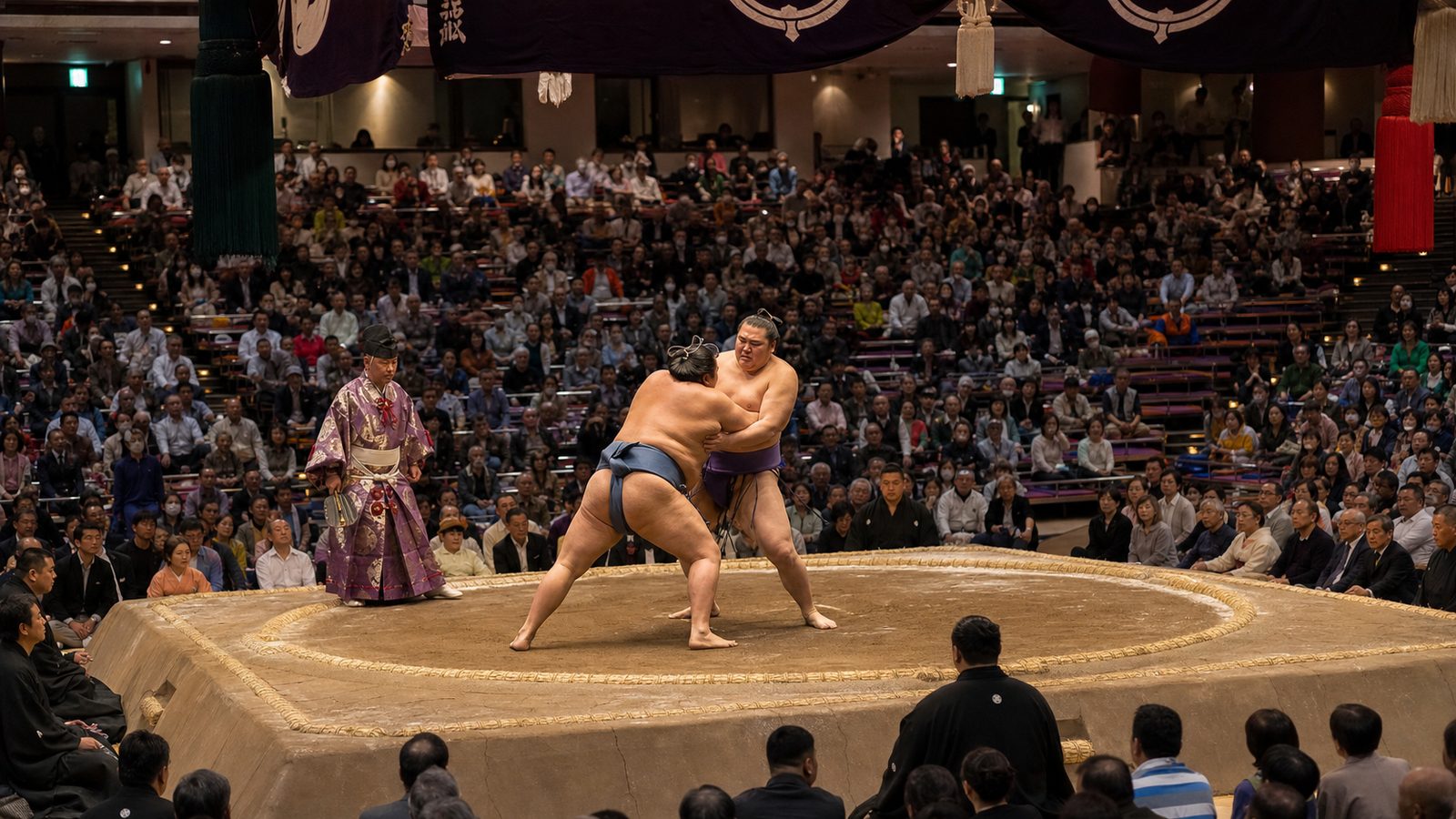
Sumo only runs six 15-day tournaments a year, in fixed cities, and tickets go through one official channel that sells out fast — plan around the schedule, buy through Ticket Oosumo, and show up early afternoon if you just want the top-division ceremony and bouts without a full day at the venue. Everything else — box seats vs. chair seats, morning practice visits, what actually happens hour by hour — comes down to those two constraints.
The six honbasho, and which ones are still on the 2026 calendar
Grand sumo runs on a fixed yearly cycle: six honbasho (grand tournaments), each 15 consecutive days, rotating through the same four cities in the same months every year.
| Tournament | Month | City | Venue |
|---|---|---|---|
| Hatsu Basho | January | Tokyo | Ryogoku Kokugikan |
| Haru Basho | March | Osaka | EDION Arena Osaka |
| Natsu Basho | May | Tokyo | Ryogoku Kokugikan |
| Nagoya Basho | July | Nagoya | IG Arena (Aichi International Arena) |
| Aki Basho | September | Tokyo | Ryogoku Kokugikan |
| Kyushu Basho | November | Fukuoka | Fukuoka Kokusai Center |
As of late July 2026, the Nagoya Basho has already wrapped up (it ran July 12–26). That leaves two tournaments still ahead this year: the Aki Basho in Tokyo, September 13–27, 2026, and the Kyushu Basho in Fukuoka, November 8–22, 2026. If you’re planning a trip around watching sumo, those are your two windows for the rest of the year — always double-check exact dates on the Japan Sumo Association’s official site closer to your trip, since schedules are confirmed well in advance but venues occasionally shift.
How tickets actually work
The only official ticket channel is Ticket Oosumo (sumo.pia.jp/en), run by Ticket Pia in partnership with the Japan Sumo Association. This matters more than it sounds — resale and scalper sites circulate for popular days, and the Sumo Association explicitly disclaims responsibility for tickets bought anywhere else. If a price looks unusually high for a weekend or the final days of a tournament, that’s your signal you’re not on the official site.
Advance sales typically open about a month before each tournament, and popular days — weekends, the final few days, anything with a yokozuna in form — can sell out within minutes. For the 2026 Aki Basho, advance sales opened August 8; for Kyushu Basho, September 19. If you have specific dates in mind, mark the sale date and be ready.
| Seat type | Rough price | What you get |
|---|---|---|
| Masu-seki (box seats) | ~¥34,000–60,000+ per box (2–4 people, sold as a full box) | Floor-level Japanese-style box, sit on cushions; most atmospheric, closest to the action |
| Arena/chair seats (S/A/B/C) | ~¥3,500–11,000 per seat | Western-style seating in the upper tiers; price depends on class and weekday vs. weekend |
| Same-day unreserved seats | Low, when available | A small number of walk-up seats have historically been sold at the box office morning-of, but availability has become inconsistent in recent years — don’t build a trip around this, treat it as a bonus if it’s on offer |
Note that masu-seki boxes are sold as a complete unit, not per person — two people booking a box still pay for all four seats, so it’s a better deal in a group than solo. Prices above are a general range pulled from recent tournaments; check Ticket Oosumo for the actual price grid before you book, since it varies by tournament, day, and seat class.
If navigating a mostly-Japanese ticketing interface isn’t appealing, guided tournament packages are worth considering — a Tokyo Sumo Wrestling Tournament Tour bundles an English-friendly viewing ticket with some context on what you’re watching, which is a reasonable trade-off for a first visit even at a premium over booking directly.
What actually happens during a day at the venue
Sumo runs on rank, and the schedule reflects it. Doors typically open in the morning (around 8–10am depending on the day of the tournament), and the lowest divisions — jonokuchi, jonidan, sandanme, makushita — wrestle through the morning and early afternoon to a mostly empty arena. Most first-time visitors skip this part entirely.
The energy builds through the afternoon:
- Around 2pm — the jūryō division (the second-highest tier) begins, and the crowd starts filling in
- Mid-to-late afternoon — the makuuchi (top division) wrestlers enter for their ring-entering ceremony, dohyo-iri, in their ceremonial aprons
- Shortly after — any yokozuna (grand champions) perform their own, more elaborate dohyo-iri with two attendants
- Early evening, ending around 6pm — makuuchi bouts run, building to the final match of the day, which carries the most prestige
If you don’t want to commit to a full day, arriving in the early-to-mid afternoon for the jūryō division onward gets you the ceremony and the best bouts without the long wait through the lower divisions. Unlike a stable visit, eating and drinking at your seat is completely normal — bento boxes and chanko nabe are sold at the venue, and box seats especially are built around groups snacking through the day.
Etiquette: what to actually know before you go
- No flash photography, and no video during the actual bouts — photos between matches are fine, but respect the no-video rule once wrestlers are in the ring
- The dohyo (ring) is treated as sacred ground — women are still barred from stepping onto it, which occasionally makes news when officials break with tradition
- Cushion-throwing happens when a top wrestler upsets a yokozuna — it’s a real, spontaneous crowd tradition, but it’s technically against the rules and not something a first-time visitor should try starting
- Dress is casual — there’s no dress code for spectators; this isn’t a tea ceremony
Watching morning practice (asageiko) at a stable
Morning practice is the other way to see sumo up close, and it’s a completely different experience — no crowd, no announcer, just wrestlers training in near-silence starting as early as 5:30–7:30am, with lower-ranked wrestlers first and the stable’s top sekitori joining later.
The honest reality: most stables no longer take casual walk-in visitors, and policies have tightened over the past few years. The reliable way to see asageiko as a tourist is through a licensed tour operator that has an existing arrangement with a specific stable — not by showing up and asking. If you book one of these tours, the etiquette is strict and non-negotiable: stay completely silent, no flash photography, no video at all in most cases, sit properly without pointing the soles of your feet at the practice, remove hats, silence your phone, and don’t eat or drink. Guides will walk you through the specifics of that stable’s rules before you go in, and you should follow them exactly — these are working training sessions, not a show being put on for visitors.
FAQ
Do I need to speak Japanese to buy tickets or attend? No. Ticket Oosumo has an English interface, and the venues are used to international visitors. Announcements are in Japanese, but the flow of the day (rank order, ceremonies, bout structure) is easy to follow without understanding the language.
Is it worth going if I can only catch part of a day? Yes — arriving in the early-to-mid afternoon for jūryō and the makuuchi ring-entering ceremony gives you the most visually striking parts of the day without needing to sit through the lower-division bouts in the morning.
Can I just show up and buy a ticket at the door? Don’t count on it. A limited number of same-day unreserved seats have historically existed, but availability has become inconsistent, and popular tournament days sell out in advance through Ticket Oosumo. Treat advance booking as the plan and a same-day seat as a lucky bonus.
What if I’m visiting outside a tournament month? You can still watch asageiko through a licensed tour if a stable is accepting visitors, or visit the Sumo Museum near Ryogoku Kokugikan, but there’s no substitute for a live honbasho if watching an actual match is the goal — plan your trip around the six fixed tournament windows if that matters to you.
This article contains an affiliate link. If you book through it, we may earn a small commission at no extra cost to you.