Japanese bass lures are built the way they are because Japanese bass have seen everything — the fishing pressure here forced anglers toward finesse techniques, and the lures followed. I fish rivers in Gifu Prefecture every week and Lake Biwa often enough to know the difference firsthand. This isn’t a spec-sheet roundup; it’s what actually happens when you fish this country’s water with this country’s tackle, plus the permit and etiquette details a US angler won’t find anywhere else.
The Lake Biwa Fish That Explains Everything
Start with the number that gets bass anglers’ attention: the largemouth bass world record was caught in Lake Biwa. Manabu Kurita landed a 22 lb 4 oz (10.12 kg) fish there on July 2, 2009. The IGFA lists it as a tie, not an outright win — under IGFA rules, a record under 25 lbs has to be beaten by at least 2 ounces, and Kurita’s fish came in at exactly the same weight as George Perry’s 1932 catch from Montgomery Lake, Georgia. Two fish, 77 years apart, tied to the ounce.
Lake Biwa is Japan’s largest lake, about an hour from Kyoto and Osaka, and it draws serious numbers of anglers — on a good weekend day, as many as 500 to 600 boats will launch. I live about an hour’s drive from the lake myself and fish it regularly. What that record-tying catch doesn’t tell you is the other half of the story: Lake Biwa bass have been targeted by that much pressure for decades, and it shows in how hard they are to fool. That’s the environment Japanese lure design comes out of.
Why Japanese Bass Fishing Is Different
The logic runs in one direction, and it’s worth laying out explicitly because it explains almost everything else in this article:
Heavy fishing pressure → finesse techniques → precision lures.
Japan’s bass fields are small relative to the number of anglers fishing them, and popular water gets fished hard, every week, by people using increasingly refined tackle. Bass in that kind of environment get wary fast. They’ve seen big, loud, generic baits before, and they’ve learned to avoid them. Japanese anglers responded by scaling down — lighter lines, smaller profiles, slower and more deliberate presentations.
Two techniques that came directly out of this pressure are now standard in tournament fishing worldwide, and both were invented by the same person: Haruhiko Murakami, in the late 1980s. The drop shot rig (down-shot rig) was built specifically to get a bait in front of bass that had stopped reacting to conventional retrieves. The neko rig, a drop-shot derivative where a tungsten nail weight is inserted into a soft-plastic worm, came out of the same problem. Both were later picked up by US pro anglers and are now tournament staples — techniques that started on pressured Japanese water and worked their way back across the Pacific.
Worth a correction here, since it’s a common mix-up: the wacky rig is not a Japanese invention. Its origin is disputed among a few US claims — Toledo Bend, New Jersey, South Texas — and it was first written up in Bassmaster magazine in 1979. Drop shot and neko are the Japanese exports; wacky isn’t one of them.
This is also why Japanese hard baits tend to feel different in hand than most American tackle — tighter tolerances, more deliberate action, built for fish that are actively suspicious of anything that looks fake. It’s not decoration. It’s a direct response to fishing pressure that most US anglers haven’t experienced.
The Rivers I Actually Fish
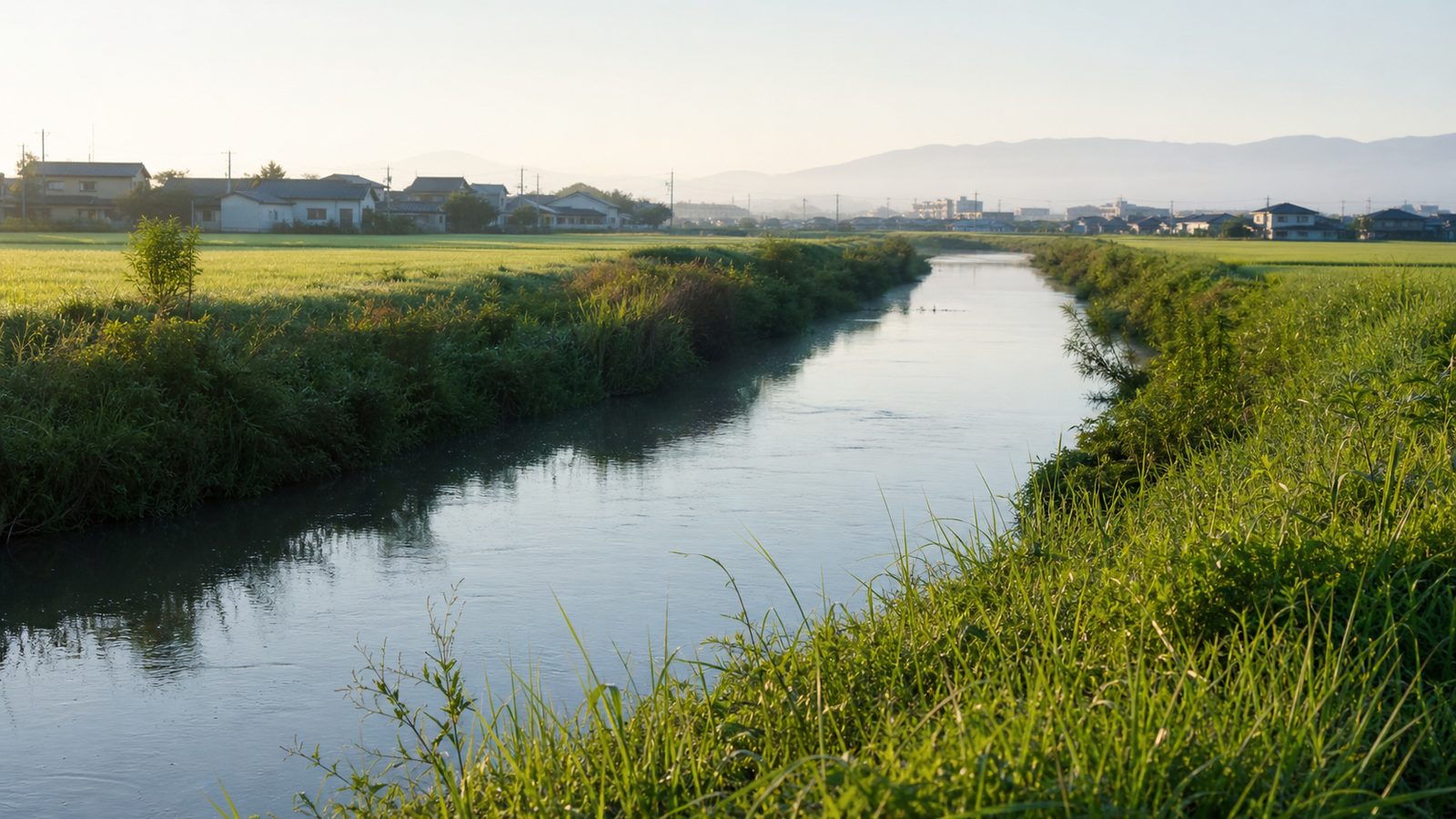
I fish bass regularly in a handful of Gifu Prefecture waters: the Gosan River, the Ooe River, the Nagara River, and the Yoro water system. Each one teaches you something different about pressure and technique.
The Gosan River, in Yoro-cho, Yoro-gun, is about 6 km long and shallow — roughly 2 meters deep through most of it. It’s a well-known field in the Chubu region, and it gets crowded on weekends, which tells you something on its own about how much attention Japanese anglers pay to small water.
The Ooe River, in Kaizu City, is a Class-A river in the Kiso River system and one of the most heavily fished bass rivers in the prefecture. Anglers drive in from Aichi and Mie to fish it, and weekends get genuinely busy.
The Nagara River is one of the “Kiso Three Rivers” and considered one of Japan’s three great clear-water rivers — the Nihon San Dai Seiryu. Sections managed by fisheries cooperatives require a day permit, same as the others.
All of these rivers run between farmland and residential neighborhoods, not through wilderness — a detail that matters more than it sounds like it should, and I’ll come back to it below.
Four Japanese Lures Worth Trying First
Japanese tackle brands generally sit at a premium price point compared to mainstream American hard baits, and that premium buys you precision more than flash. Here are four I’d point a US bass angler toward first, chosen for range of technique rather than a single “best” pick.
| Lure | What It’s Built For | Link |
|---|---|---|
| Megabass Vision 110 Jerkbait | Suspending jerkbait — the bait top pros are still throwing at the Bassmaster Classic when conditions call for a jerkbait. Fishing it means long pauses and subtle twitches getting reaction bites that a straight retrieve won’t. | View on Amazon |
| Deps EVOKE 2.0 | From Deps, the brand most Japanese anglers reach for on swimbaits and glide baits. It’s a lower-commitment way to see what that brand’s build quality feels like before investing in a full glide bait rotation. | View on Amazon |
| Evergreen SB Topwater Plug Surface 88 Full Metal | Evergreen is the go-to Japanese brand for topwater, and this is a full-metal-body plug — walking it across calm morning water on the Gosan or Ooe is where I’ve had some of the most explosive strikes I get all season. | View on Amazon |
| O.S.P ECO High Pitcher | O.S.P is a tournament-grade brand in Japan — the kind anglers pick up specifically when the water’s been hit hard and the usual baits have stopped working. Worth having in the box for pressured, picked-over spots. | View on Amazon |
None of these is a universal “best” choice — a jerkbait, a swimbait/glide bait, a topwater plug, and a pressured-water option cover different situations, and which one earns a spot in your box depends on what kind of water you’re fishing.
Fishing Permits in Japan: What US Anglers Need to Know
Here’s the part that surprises most American readers: Japan has no state-issued fishing license system at all. There’s no equivalent of a state DNR license you buy once for the year.
Instead, water managed by a fisheries cooperative (漁協) requires a day permit — a yūgyoken (遊漁券) — purchased for that specific day on that specific water. On the Gosan and Ooe rivers, a day permit costs ¥300, sold through the Yoro Fisheries Cooperative and Kaizu City Fisheries Cooperative respectively. Nationally, day permits typically run anywhere from ¥500 to ¥2,500 depending on the water.
You can usually buy a permit at a local tackle shop or directly from the fisheries cooperative, and in some locations at a convenience store or through an app like FISHPASS. Foreign visitors are allowed to buy day permits — this isn’t restricted to residents — but I’d recommend contacting the local fisheries cooperative in advance rather than showing up and hoping. There’s also a law, the Act on Regulation of Foreign Fishery, that can impose additional restrictions on foreign nationals in certain locations, so confirming ahead of a trip is worth the extra step.
Release Rules You Need to Know Before You Fish
This is where things get genuinely confusing if you’re used to a single set of state rules, because different species and different prefectures are treated completely differently.
Largemouth bass in Gifu Prefecture: no rule against releasing them. You can release a fish where you caught it, same as most of the fishing I do on the Gosan, Ooe, and Nagara.
Smallmouth bass in Gifu Prefecture: catch-and-release is banned prefecture-wide. This comes from a directive by the Gifu Prefecture Inland Fisheries Management Committee, in effect from April 1, 2026 through March 31, 2029, and there are penalties for violating it.
Nationally, Japan’s Invasive Alien Species Act (in effect since 2005) does not ban catch-and-release itself — releasing a fish back where you caught it is fine under that law. What it bans is 放流 — transporting a live fish and releasing it somewhere other than where it was caught. Violating that carries penalties of up to 3 years imprisonment or a ¥3,000,000 fine for individuals.
On top of the national law, individual prefectures can ban catch-and-release outright within their borders, and several do: Shiga, Nagano, Yamanashi, and Niigata. Shiga is where Lake Biwa sits — so the lake that produced the world-record-tying fish is also, on paper, a lake where the rules ask you not to put your catch back.
How that plays out on the water is a longer conversation, and one Japanese anglers have been having among themselves for years. As a visitor, though, the answer is simple: read the signage at the launch, ask at the shop where you buy your permit, and do what they tell you. Rules like these exist because bass are legally an invasive species here, not because anyone is trying to ruin your day.
Etiquette: How Not to Be the Reason Access Gets Closed
The Gosan and Ooe rivers run between farmland and residential neighborhoods — this is people’s everyday living space, not a wilderness area, and it changes how you should behave on the bank. This is courtesy, not law, but it matters:
- Don’t block farm roads. Local farmers use light trucks (keitora) on them daily, and a parked car in the wrong spot is a real problem for someone trying to work.
- Park only in designated areas.
- Pack out everything — line scraps, worm packaging, all of it.
- Keep noise down early in the morning. Houses are close to the water.
- If you cross paths with a local resident, greet them.
In Japan, the most common reason access to a fishing spot gets shut down isn’t the fishing itself — it’s angler misconduct. Bad parking, trash left behind, noise complaints. Being a good guest on the water is the single easiest thing you control as a visitor, and it’s the reason spots like these stay open for the next angler.
FAQ
Do I need a fishing license to bass fish in Japan? No — Japan doesn’t have a state-issued license system like the US. What you need instead is a day permit (yūgyoken) for the specific water you’re fishing, purchased from a tackle shop or the local fisheries cooperative.
Can I release the bass I catch in Japan? It depends on the species and the prefecture. Largemouth bass can generally be released in Gifu. Smallmouth bass cannot be released anywhere in Gifu as of an April 2026 directive. Several prefectures, including Shiga (Lake Biwa), Nagano, Yamanashi, and Niigata, ban catch-and-release outright regardless of species.
Why are Japanese bass lures more expensive than typical American hard baits? They’re built for a different problem — bass in Japan see heavy fishing pressure and have grown wary of typical presentations, so Japanese brands prioritize precision and finesse action over mass-market pricing. That build quality is reflected in the price.
Did the wacky rig come from Japan too? No. That’s a common assumption, but the wacky rig’s origin is disputed among a few competing US claims and was first documented in Bassmaster magazine in 1979. The drop shot and neko rigs are the Japanese-born techniques — wacky isn’t one of them.
This article contains affiliate links. If you buy through them, we may earn a commission at no extra cost to you.