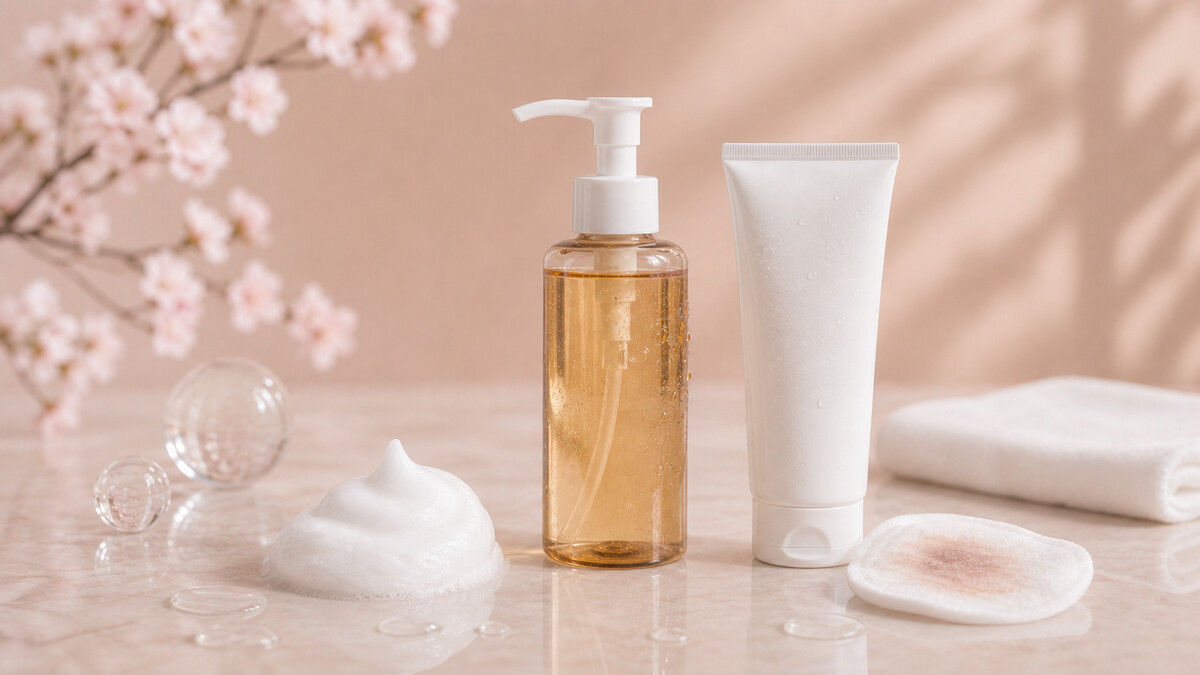
Starting a cleansing routine with oil feels backwards if you have oily or acne-prone skin, but the logic is sound: oil dissolves oil-based impurities (sunscreen, makeup, sebum buildup) far more effectively than a water-based cleanser can, and a proper oil cleanser rinses clean rather than leaving residue. The fear that it will make oily skin oilier is based on how the product feels going on, not what actually happens once it’s rinsed off.
The two-step logic
A Japanese double-cleanse routine uses an oil-based cleanser first, to dissolve sunscreen, makeup, and the oil-based debris that accumulates through the day, followed by a gentle foaming cleanser second, to clear away water-based grime and whatever residue the oil step left behind. Each step is doing a job the other genuinely can’t — a water-based cleanser alone often can’t fully break down sunscreen or heavy makeup, which is part of why some people who skip the oil step still feel like their skin isn’t properly clean by evening.
Why this doesn’t worsen oily or acne-prone skin
The instinct to avoid oil on oily skin makes sense on the surface but misunderstands what’s happening. A well-formulated cleansing oil emulsifies with water and rinses away completely, taking excess sebum and pore-clogging buildup with it rather than adding to it. The products that give oil cleansing a bad reputation are typically heavy, poorly emulsifying oils not designed for this — not the concept itself.
A well-known starting point
Hada Labo Gokujyun Hyaluronic Acid Cleansing Oil is one of the most recommended entry points, built around the same hyaluronic-acid-forward, minimal-fragrance philosophy that made Hada Labo a starter brand for J-beauty in general. It’s a reasonable way to try the double-cleanse method without committing to a more expensive specialty cleansing oil first.
Getting the technique right
The most common mistake isn’t the product — it’s rinsing too soon. Apply the oil cleanser to completely dry skin and hands (water breaks the emulsification process early), massage for a genuine 60 seconds to let it dissolve makeup and sunscreen, and only then add water to emulsify it into a milky texture before rinsing. Adding water too early is why some people find oil cleansers “don’t work” — the product needs time on dry skin to do its job first.
Who should be more cautious
Very reactive or eczema-prone skin can be sensitive to certain oils or fragrance in cleansing oils, so patch-testing a new product on the inner arm first is a reasonable precaution — not because the method is risky in general, but because any new product carries that same basic risk.
FAQ: Double cleansing with oil
Will an oil cleanser make my oily skin worse? No, when used correctly — a properly formulated oil cleanser rinses away completely rather than sitting on skin, taking excess sebum with it rather than adding to it.
Do I need to double cleanse every day? It matters most on days you’ve worn sunscreen or makeup, since that’s what the oil step is specifically dissolving. On bare-skin days, a single gentle cleanse is often enough.
What’s the biggest mistake people make with oil cleansing? Adding water too early. The oil needs roughly 60 seconds of massage on completely dry skin to dissolve makeup and sunscreen before water is introduced to emulsify and rinse it.
Is oil cleansing suitable for acne-prone skin? Generally yes — many oil cleansers are non-comedogenic and formulated not to clog pores. Very reactive skin should patch-test any new cleanser, oil-based or not, before full use.