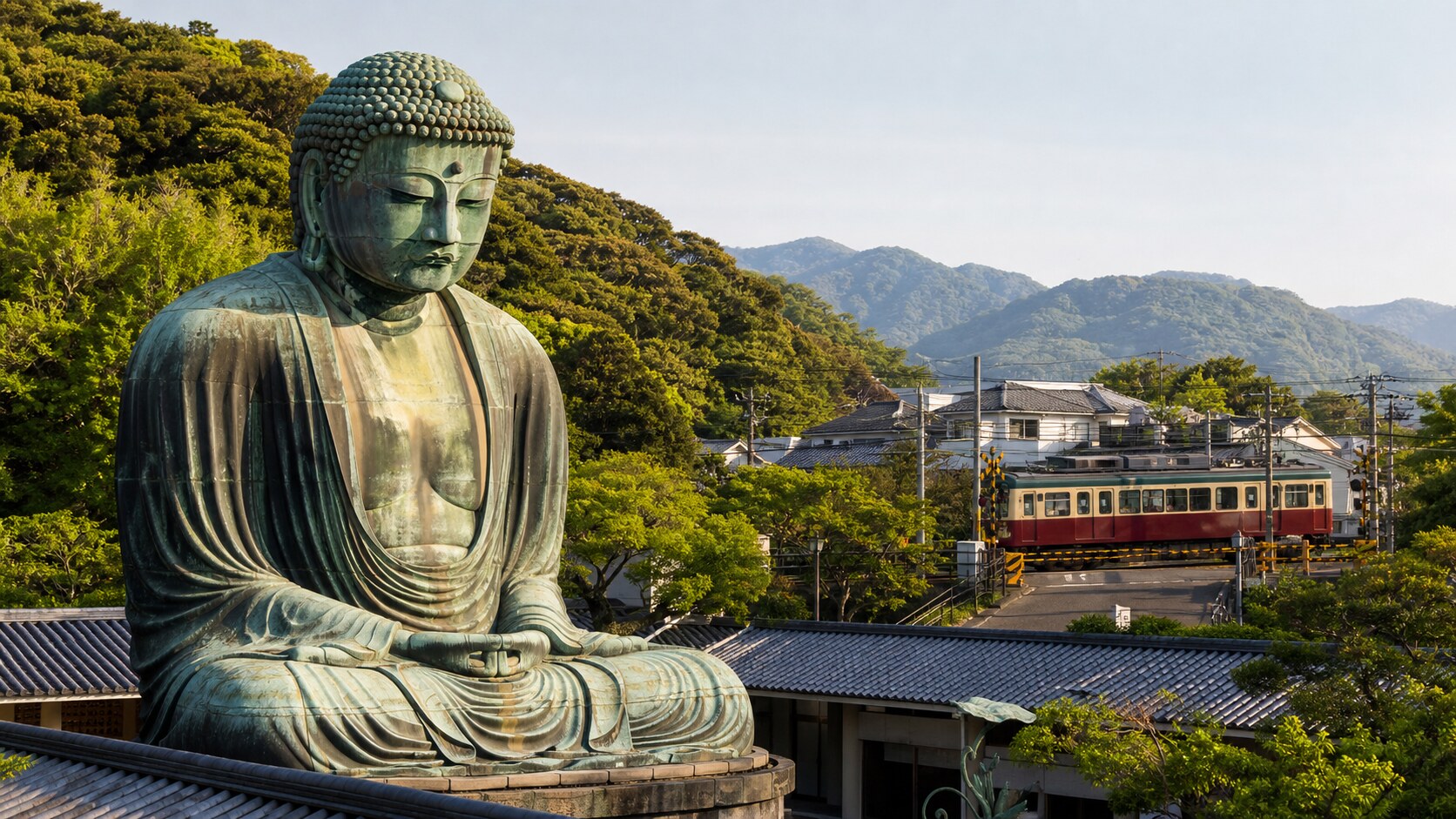
Kamakura and Yokohama are genuinely easy same-day trips from Tokyo — under an hour each way, no overnight needed. Hakone and Nikko technically work as day trips too, but both reward an overnight far more than the extra planning costs. The mistake most first-timers make isn’t picking the wrong destination, it’s picking a destination that suits an overnight and then rushing it into a single day because “day trip” was the plan from the start.
Kamakura — the easiest yes
About an hour from Tokyo Station on the JR Yokosuka Line, Kamakura is the day trip with the least room for regret. The Great Buddha (Kotoku-in), Hase-dera’s hillside gardens, and a walk along the Enoden line to Enoshima cover a full, satisfying day without feeling rushed. It’s compact enough that you’re not spending half your day on trains.
Best for: first-timers who want a genuine change of scenery — temples, coastline, a slower pace — without complex logistics.
Yokohama — the “doesn’t feel like a day trip” trip
25 minutes from Shinjuku on the JR Shonan-Shinjuku Line, Yokohama is close enough that it barely counts as leaving Tokyo, but the Minato Mirai waterfront and Japan’s largest Chinatown (600+ restaurants) feel like a genuinely different city. This is the trip to pick on a day when energy is lower — the payoff-to-effort ratio is the best of any option here.
Best for: a half-day or evening trip, easily combined with a late departure or an early return.
Hakone — works as a day trip, better as an overnight
Hakone is roughly 90 minutes from Tokyo and technically doable in a day: the Hakone Freepass covers the ropeway, pirate-ship cruise across Lake Ashi, and (on clear days) Mount Fuji views. The problem is that doing all of it in a single day means constantly checking the clock instead of actually enjoying an onsen town — which is the entire point of Hakone.
If you only have a day: prioritize the Owakudani ropeway and Lake Ashi cruise; skip the museums. If you can stay overnight: a ryokan with a private onsen turns Hakone from “a lot of walking with a mountain view” into the actual highlight of a Japan trip. Given how close it is to Tokyo, this is one of the easiest overnight upgrades to justify.
Nikko — the one most likely to disappoint as a rushed day trip
Nikko is about 2 hours from Tokyo, and the shrine complex (Toshogu, with its famously ornate carvings) alone deserves 3–4 hours if you’re not speed-walking through it. Factor in the round-trip travel time and a day trip leaves you choosing between seeing Toshogu properly or adding Kegon Falls and Lake Chuzenji — rarely both. Nikko is the destination on this list where “I wish I’d stayed over” comes up most often.
Best for: travelers specifically prioritizing Toshogu Shrine over the surrounding nature; budget the full day for the shrine complex alone if going without an overnight.
How to actually decide
| Destination | Round-trip travel | Works as a day trip? | Overnight upgrade worth it? |
|---|---|---|---|
| Kamakura | ~2 hours | Yes, comfortably | Not really necessary |
| Yokohama | ~50 minutes | Yes, easily | No — it’s a city, not a retreat |
| Hakone | ~3 hours | Yes, but rushed | Yes — onsen ryokan is the point |
| Nikko | ~4 hours | Barely | Yes — otherwise you’ll shortchange the shrine |
Getting there without overthinking it
For Kamakura and Yokohama, standard JR tickets or a Suica/Pasmo IC card cover everything — no special pass needed. For Hakone, the Hakone Freepass (covering the ropeway, cruise, and local transport) is worth it the moment you use more than two of its included rides. For Nikko, a Nikko Pass from Tobu Railway similarly pays for itself if you’re visiting more than just the shrine.
None of these destinations require a JR Pass on their own — that only makes sense if they’re one leg of a longer Shinkansen-heavy itinerary.
FAQ: Day trips from Tokyo
Which day trip from Tokyo is best for first-timers? Kamakura. It has the best balance of cultural sights, walkability, and low logistical complexity — you won’t spend the day worrying about train transfers.
Is Hakone worth it as just a day trip? Yes, but you’ll be choosing between the ropeway/cruise and the museums rather than doing both unhurried. If Mount Fuji views and an onsen are the goal, an overnight makes a noticeably better trip for not much extra planning.
Can I do Nikko and Kamakura on the same trip? Not on the same day — they’re in opposite directions from Tokyo and each deserves its own day. If time allows, treat them as two separate excursions rather than combining them.
Do I need a JR Pass for these day trips? No. Standard tickets or a Suica/Pasmo IC card cover Kamakura and Yokohama, and destination-specific passes (Hakone Freepass, Nikko Pass) are the better value for those two — a JR Pass only makes sense if you’re also taking long-distance Shinkansen rides elsewhere in your trip.