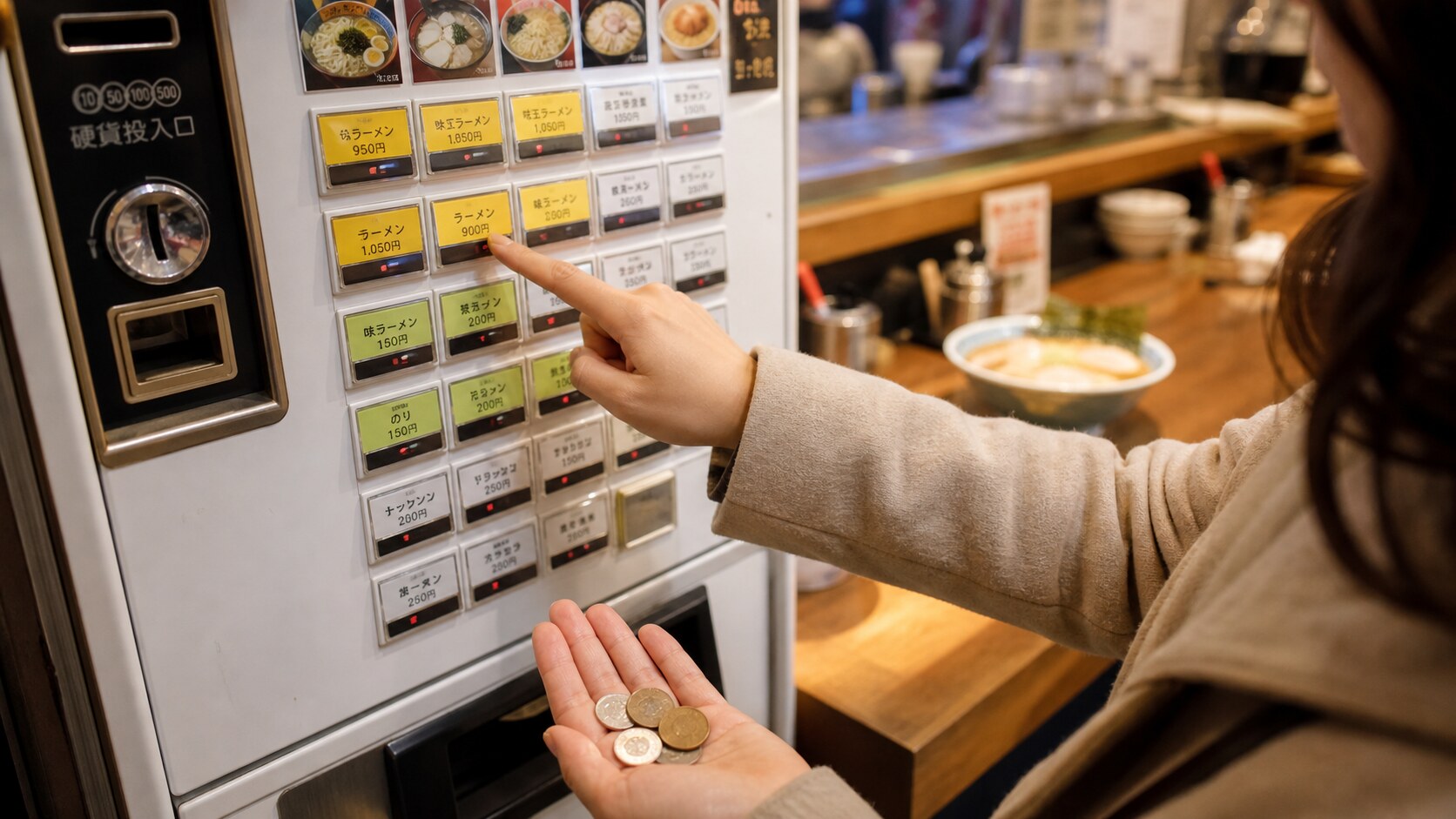
Most ramen shops don’t have a server take your order — you order and pay at a vending machine by the entrance first, then hand a printed ticket to the counter staff, who cook and deliver the bowl. The system is simple once you know it, but standing at an all-Japanese machine with a line forming behind you is exactly the kind of small moment that trips up first-time visitors. Knowing the sequence in advance turns it from stressful into routine.
The actual sequence
- Insert cash first, before pressing any buttons. Most machines expect payment before selection, not after.
- Press the button for what you want. Buttons usually show a photo and price; if there’s no English, the dish in the top-left position is very commonly the standard or most-recommended option — a reliable default when you can’t read the labels.
- Collect your ticket and any change.
- Hand the ticket to counter staff as you take a seat — this is the cue that tells them what to cook, not a receipt you keep.
The cash detail that trips people up
Machines frequently don’t accept large bills — ¥5,000 or ¥10,000 notes often won’t feed in. Having ¥1,000 notes on hand before you approach the machine avoids the awkward moment of needing to ask staff to break a large bill (which they’ll do, but it holds up the line and adds friction you can skip entirely).
If you can’t read the machine at all
This happens even to people with some Japanese ability, since menu names and regional ramen terms don’t always match textbook vocabulary. Two reliable fallbacks: watch what the person ahead of you does (Japanese queue culture is patient, and no one will mind a few extra seconds of you observing before pressing anything), or simply pick the top-left button, which is very often the shop’s standard or signature bowl.
Adding toppings and customization
Many machines have separate buttons for common add-ons — an extra egg (tamago), extra noodles (kaedama), or extra chāshū (pork) — purchased as additional tickets alongside your main bowl. If a shop allows firmness or richness customization (noodle firmness, broth richness, garlic amount), that’s more commonly asked verbally by staff after you’re seated, not selected on the machine itself.
What happens after you sit down
Handing over your ticket is typically the extent of the interaction needed — staff will call out or bring the bowl once it’s ready, often without further questions unless customization options are offered. Eating quickly and without lingering afterward is the norm at most ramen counters, particularly in Tokyo, where turning tables efficiently is part of the culture, not a sign you’re unwelcome to relax.
FAQ: Ordering ramen in Japan
What if the ticket machine doesn’t have English? Watch what the person ahead of you orders, or default to the top-left button, which is commonly the shop’s standard or recommended bowl. Staff are generally used to helping tourists at this exact moment.
Do I pay before or after eating? Before — you pay at the machine when ordering, then hand your ticket (not cash) to the counter staff as proof of purchase when you sit down.
What if the machine won’t accept my bill? Large bills (¥5,000/¥10,000) are often rejected. Ask staff to help break the bill, or come with smaller denominations, ideally ¥1,000 notes, to avoid the issue entirely.
Is it rude to ask staff for help with the machine? No — this is a common, expected moment for tourists, and staff at ramen shops in tourist-heavy areas are generally accustomed to it.