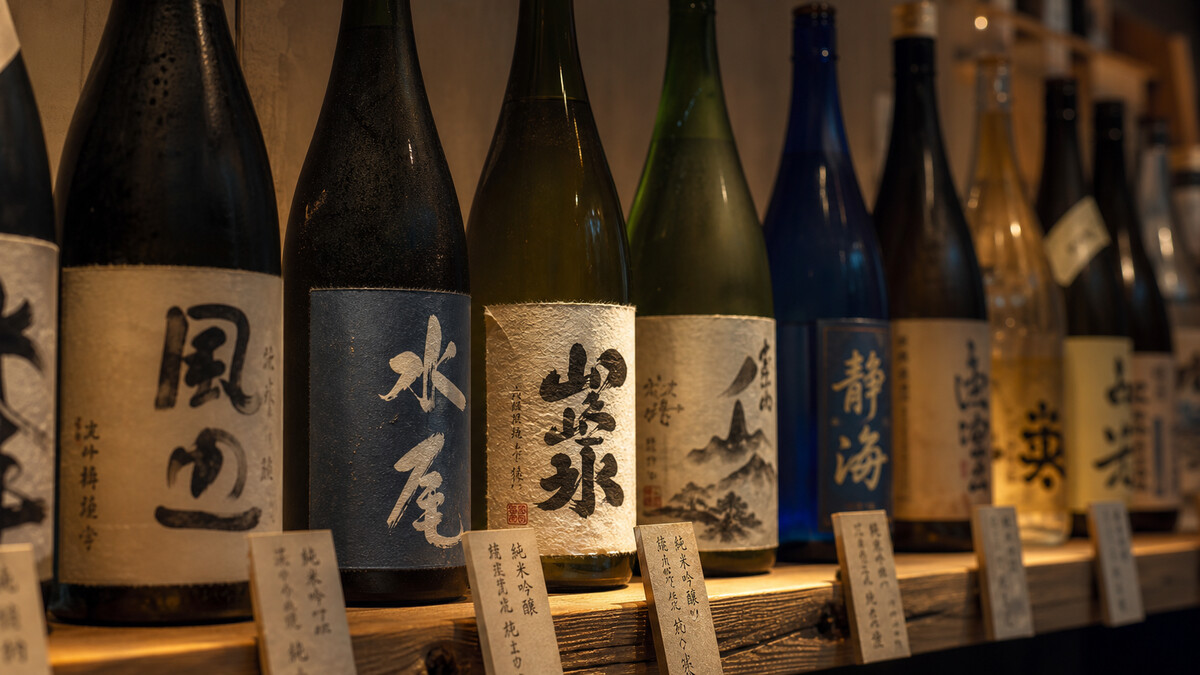
The short version: junmai tells you what’s in the sake (pure rice, no added alcohol), while ginjo and daiginjo tell you how much the rice was polished before brewing. These aren’t competing categories — a bottle can be both junmai and daiginjo at the same time. Once you know that these two label systems are answering different questions, sake labels stop looking like a wall of unfamiliar words and start being genuinely useful information.
The first thing to check: is it junmai?
Junmai (純米) means the sake is made from just rice, koji, water, and yeast — no added brewer’s alcohol. Sake without “junmai” on the label typically has a small amount of distilled alcohol added during brewing, a technique used to adjust aroma and flavor rather than to cut costs in modern premium sake. Neither approach is objectively “better” — junmai tends to have a fuller, more rice-forward flavor, while non-junmai sake is often lighter and more aromatic. It’s a style difference, not a quality hierarchy.
The second thing to check: how much was the rice polished?
This is what ginjo and daiginjo actually describe. Before brewing, the outer layer of each rice grain is milled away, because the starch at the center produces cleaner flavors than the outer layer, which contains more fat and protein. The percentage of the original grain remaining after polishing is called the seimaibuai (精米歩合), and it’s usually printed right on the label.
| Term | Rice remaining after polishing | General flavor tendency |
|---|---|---|
| (no ginjo designation) | 70% or more remains | Fuller-bodied, more rice character |
| Ginjo | 60% or less remains | Fruitier, more aromatic |
| Daiginjo | 50% or less remains | Very light, highly aromatic, often more delicate |
More polishing generally costs more to produce, which is part of why daiginjo bottles tend to sit at a higher price point — but “more polished” doesn’t automatically mean “better for you.” Some drinkers genuinely prefer the fuller character of a less-polished junmai over the delicate aromatics of a daiginjo.
Putting the two systems together
Because junmai and the polishing terms answer different questions, you’ll commonly see them combined on real labels:
| Label term | What it means |
|---|---|
| Junmai | Pure rice, no added alcohol, no specific polishing requirement |
| Ginjo | Added alcohol permitted, rice polished to 60% or less |
| Junmai Ginjo | Pure rice, polished to 60% or less |
| Daiginjo | Added alcohol permitted, rice polished to 50% or less |
| Junmai Daiginjo | Pure rice, polished to 50% or less |
Junmai daiginjo is generally the most labor-intensive combination to produce — pure rice with heavy polishing — which is why it often sits at the top of a brewery’s lineup and price range.
Other label terms worth knowing
- Nama (生): Unpasteurized sake, fresher and more delicate, but needs to stay refrigerated and consumed sooner.
- Nigori (にごり): Cloudy, lightly filtered sake — different from unfiltered doburoku, but similarly textured and often sweeter.
- Honjozo (本醸造): Similar to regular sake but with a small, regulated amount of added alcohol and a defined polishing ratio, generally an affordable, food-friendly category.
How to actually use this when shopping
- Don’t assume daiginjo is automatically the right choice. If you like fuller, rice-forward flavors, a well-made junmai (without the ginjo designation) might suit your palate better than an expensive daiginjo.
- Check the seimaibuai percentage if it’s printed. A lower number means more polishing — useful for comparing two bottles that both say “ginjo” but list different percentages.
- Use junmai as your filter if you want to avoid added alcohol entirely. Any label with “junmai” in it, regardless of polishing level, meets that criteria.
Bottom line
Junmai tells you what went into the bottle, and ginjo/daiginjo tell you how much the rice was polished — two separate scales, not a single quality ranking. Once you can read both at a glance, a wall of unfamiliar Japanese label terms turns into genuinely useful shopping information.
FAQ
Is junmai daiginjo always the best sake? Not necessarily “best” — it’s generally the most labor-intensive and often the most expensive, but flavor preference is personal. Some drinkers prefer the fuller character of a standard junmai.
Does a higher polishing ratio always mean better sake? No. More polishing generally produces a lighter, more aromatic profile, which isn’t objectively better — it’s a different style that some drinkers prefer and others don’t.
What sake should a beginner start with? A junmai ginjo is a reasonable starting point — it avoids added alcohol while still offering the more approachable, aromatic character that ginjo-level polishing tends to produce.
This post contains affiliate links. If you buy through a link on this page, we may earn a commission at no extra cost to you. This does not affect our recommendations.