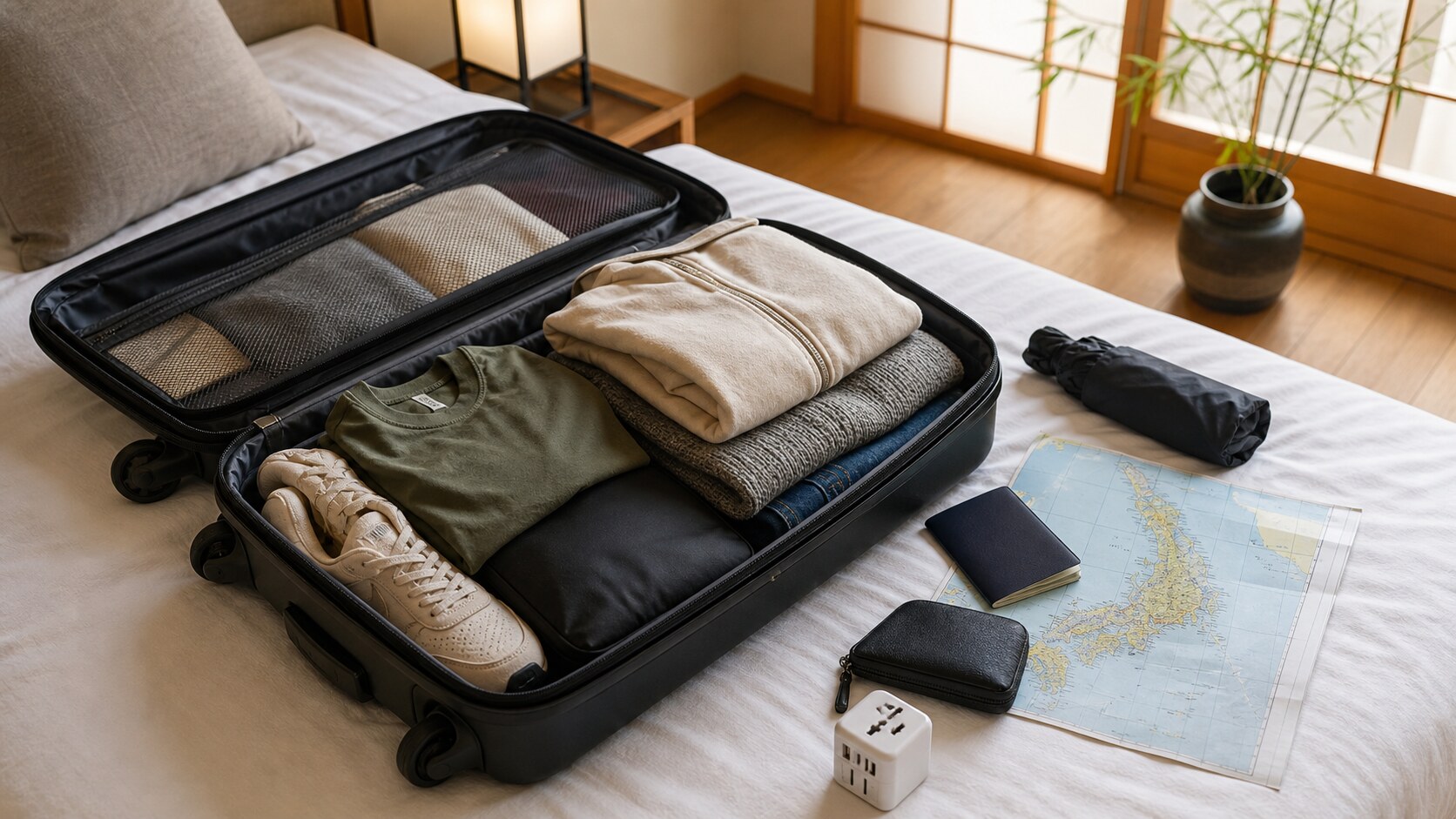
Pack less clothing than you think and more cash than you think. Japan makes doing laundry trivially easy (most hotels and even many Airbnbs have a machine, and coin laundromats are everywhere), so five days of outfits covers a two-week trip. Meanwhile, plenty of small restaurants, shrines, and local shops still don’t take cards, so arriving with zero yen and assuming you’ll “figure it out at an ATM” is how a first afternoon gets stressful. Beyond that, the single most-forgotten item isn’t a thing you pack — it’s connectivity, sorted before you land.
The two things that actually cause problems
Every Japan packing list mentions passports and chargers. Fewer mention the two things that genuinely derail a first day:
Cash, and specifically coins. Japan is far more card-friendly than it used to be, but small shrines, some ramen counters, coin lockers at train stations, and vending machines still run on cash — and Japanese vending machines and lockers often want exact coins, not bills. ¥100 and ¥500 coins pile up fast because change comes back in coins more often than in the US or Europe. A small coin purse (or just a zip pocket you dedicate to coins) saves you from the wallet-bulging mess most first-timers end up with by day three. Withdraw ¥10,000–20,000 on your first day at a 7-Eleven ATM — these reliably accept foreign cards even when other Japanese ATMs don’t.
Shoes you can slip off without unlacing. You will take your shoes off more than you expect — at temples, some restaurants, ryokan, and traditional guesthouses — and fumbling with laces in front of a line of people gets old fast. It doesn’t need to be literal slip-ons; shoes with a low-effort lacing system work fine. What matters is not needing both hands and thirty seconds every time.
The one tech decision that matters more than any adapter
A physical plug adapter is not the thing to stress about — Japan uses the same two-flat-pin plug shape as North America (Type A), so US travelers often need no adapter at all, and everyone else needs only a basic one available at any convenience store or airport kiosk.
What actually matters is connectivity from the moment you land. An eSIM you activate before departure means you have working maps, train navigation, and translation the second you walk out of customs — no hunting for airport Wi-Fi, no waiting until you reach a hotel. Given how much of navigating Japan depends on Google Maps’ train transfer directions (routes are rarely intuitive, even for short trips), this is closer to essential infrastructure than a nice-to-have. A Japan travel eSIM card installs from a QR code before you even board the flight, and the data doesn’t start counting down until you actually connect on arrival — so there’s no downside to setting it up early.
What to actually pack
- Comfortable, already-broken-in walking shoes — you’ll likely walk 15,000+ steps most days between train stations and attractions; day one is not the day to test new shoes
- A lightweight layer, regardless of season — train cars and shops run heavily air-conditioned in summer and well-heated in winter, so the temperature swing between outdoors and indoors is bigger than the season alone suggests
- A slim daypack — most attractions and train platforms involve stairs and crowds, and a bulky suitcase-style day bag is genuinely awkward on a packed Yamanote Line car
- A portable battery pack — between maps, translation, and photos, phone battery disappears faster than a normal travel day, and outlets in public spaces are not as common as in the US
- A small travel umbrella — convenience stores sell cheap ones everywhere, so this isn’t critical, but rainy-season (June) travelers will use it daily
- Basic over-the-counter medication from home — Japan has strict rules on certain common ingredients (some stimulant-based cold medicines and some prescription-strength painkillers), so bringing your usual mild pain reliever or allergy medicine avoids a pharmacy detour
What to leave at home
- A week-plus of outfits. Laundry access is common enough that packing for 4–5 days and repeating is the norm for experienced Japan travelers, not a compromise.
- A full toiletries kit. Japanese drugstores (Matsumoto Kiyoshi, Don Quijote) carry excellent versions of everything, often better than what you’d bring, and skip the liquids-in-carry-on hassle entirely.
- A JR Pass, by default. It’s easy to assume this belongs on every list, but unless your itinerary includes multiple long-distance Shinkansen legs, individual tickets or a regional pass usually cost less. Price it out for your actual route before buying.
- Excess bulky layers “just in case.” Between drugstores and fast fashion chains (Uniqlo, GU) in nearly every city, buying a heavier jacket locally if weather turns is genuinely easier than carrying one you might not need.
Practical notes
Trash cans are noticeably rare in public spaces — convenience stores are usually the most reliable place to find one, so it’s normal to carry a small bag of trash for a while. Public restrooms are common and free but don’t always stock paper towels or hand dryers, so a small packet of tissues and a handkerchief solve a problem you won’t see coming until you’re standing there.
FAQ: Packing for Japan
Do I need a plug adapter for Japan? US travelers usually don’t — Japan uses the same Type A two-flat-pin outlets. Travelers from the UK, Europe, or Australia need a basic adapter, sold cheaply at any airport or convenience store, not a specialized “Japan adapter.”
How much cash should I bring or withdraw? Landing with roughly ¥10,000–20,000 covers a first day comfortably. After that, 7-Eleven ATMs are the most consistently foreign-card-friendly option for topping up as needed, so there’s little reason to carry large amounts at once.
Is a JR Pass worth it? Only if your itinerary includes multiple long-distance Shinkansen trips (for example, Tokyo–Kyoto–Hiroshima in one trip). For a Tokyo-based trip with day trips to places like Kamakura or Nikko, individual tickets or a regional pass are usually cheaper — the JR Pass isn’t automatically the money-saver it’s reputed to be.
What’s the biggest thing first-timers forget? Sorting out an eSIM or pocket Wi-Fi before departure. Arriving with no connectivity means the first hour or two in Japan — exactly when you most need maps and train directions — is the hardest possible time to be offline.