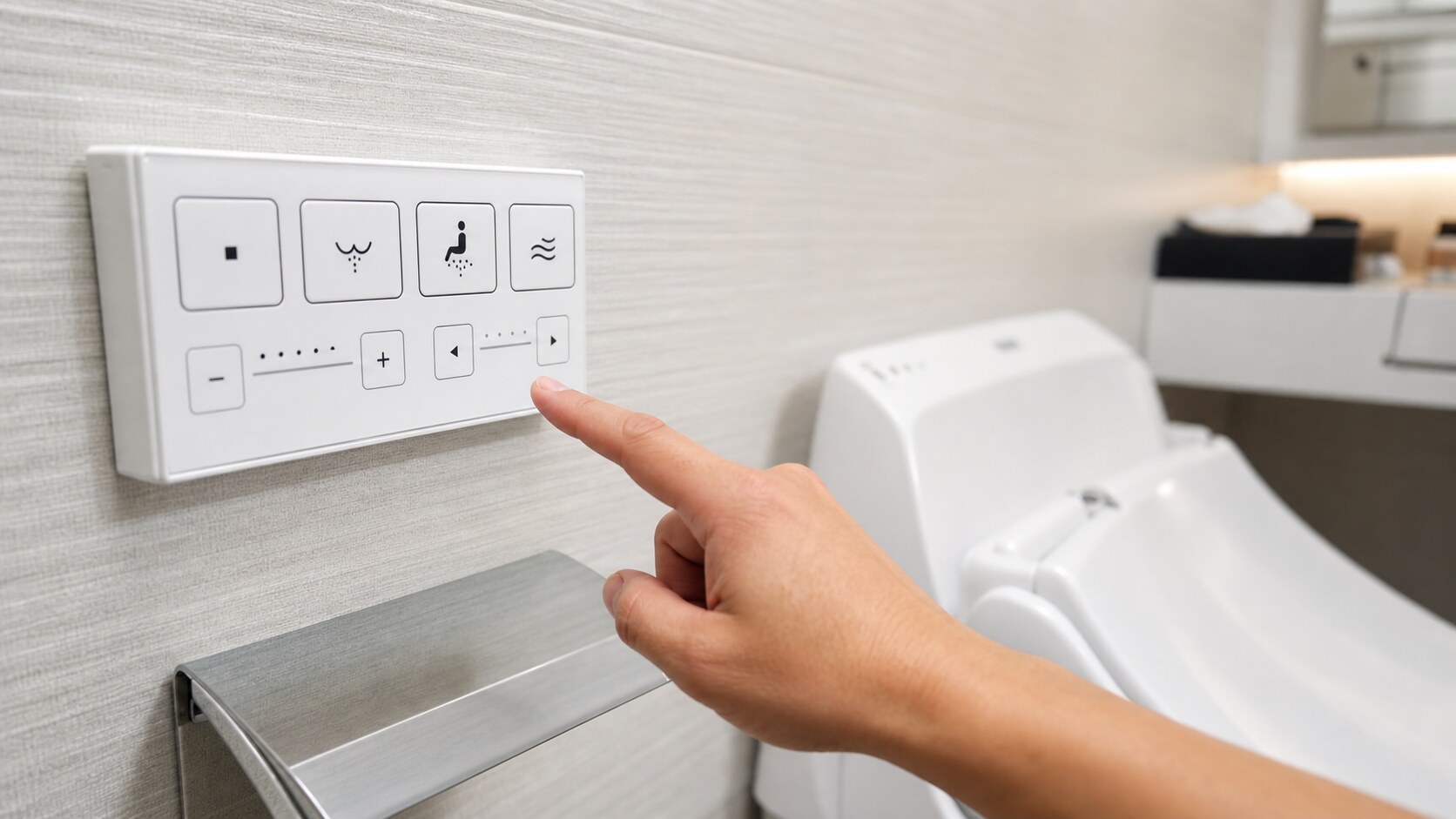
The biggest, most prominent button on a Japanese toilet control panel is very often not the flush button — it’s an emergency staff call button, and pressing it alerts hotel or restaurant staff that you need help. This single mix-up is responsible for more embarrassed tourists than any other part of using a washlet, and knowing it in advance is genuinely the most useful thing to take from this guide.
What a “washlet” actually is
Washlet is technically a TOTO brand name, but it’s become the generic term in Japan for toilet seats with built-in water-spray bidet functions. Since 2017, Japanese manufacturers agreed on standardized pictograms for the buttons specifically to help international visitors, so even without reading Japanese, the icons are more consistent and decipherable than they look at first glance.
The buttons that actually matter
- Flush — usually labeled 流す (nagasu) or shown as two options: 大 (dai, full flush) and 小 (shō, partial flush, for water conservation). If there’s no obvious flush button on the seat panel itself, check the wall — many washlets are flushed via a separate handle or wall panel, not the electronic control pad at all.
- おしり (oshiri, “rear”) — rear bidet spray.
- ビデ (bide, “bidet”) — front spray, intended for women.
- 止 or 停止 (tome / teishi, “stop”) — stops the spray immediately, worth knowing before you need it.
- 音 (oto) or a musical note icon — plays a sound (often a flushing sound) to cover noise, a privacy feature rather than a functional one.
- + / − or 圧 — adjusts spray pressure, useful to lower before your first press if you’re unsure how strong it’ll be.
The button to leave alone
The emergency call button is frequently the largest, most visually prominent button on the panel — sometimes red, sometimes simply the biggest icon — specifically because it’s designed to be easy to find in a real emergency. That same prominence is exactly why it gets mistaken for the flush button by people scanning quickly. If a button doesn’t clearly match a flush or bidet icon and is notably larger than the others, it’s worth pausing rather than pressing.
A reasonable approach if you’re unsure
Locate the physical flush handle or a clearly labeled flush button first — many toilets still have one separate from the electronic bidet controls. If the panel is entirely unfamiliar, it’s completely fine to simply not use the bidet functions and flush normally; nothing about a washlet requires using every feature to use the toilet successfully.
FAQ: Japanese toilet buttons
What’s the biggest thing to avoid on a Japanese toilet panel? Pressing the largest or most prominent button without checking what it does — it’s frequently an emergency staff call button, not the flush.
How do I flush if I can’t find an obvious button? Check for a physical handle or lever separate from the electronic control panel — many washlets flush this way rather than through the bidet button panel.
Are the bidet functions safe to try? Yes — starting with the lowest pressure setting and using the stop button (止 or 停止) if needed makes it easy to try without discomfort.
Do all Japanese toilets have these bidet functions? No — many public restrooms, especially older ones or those in train stations, have standard toilets without a washlet panel at all. Washlets are more common in hotels, homes, and newer commercial buildings.