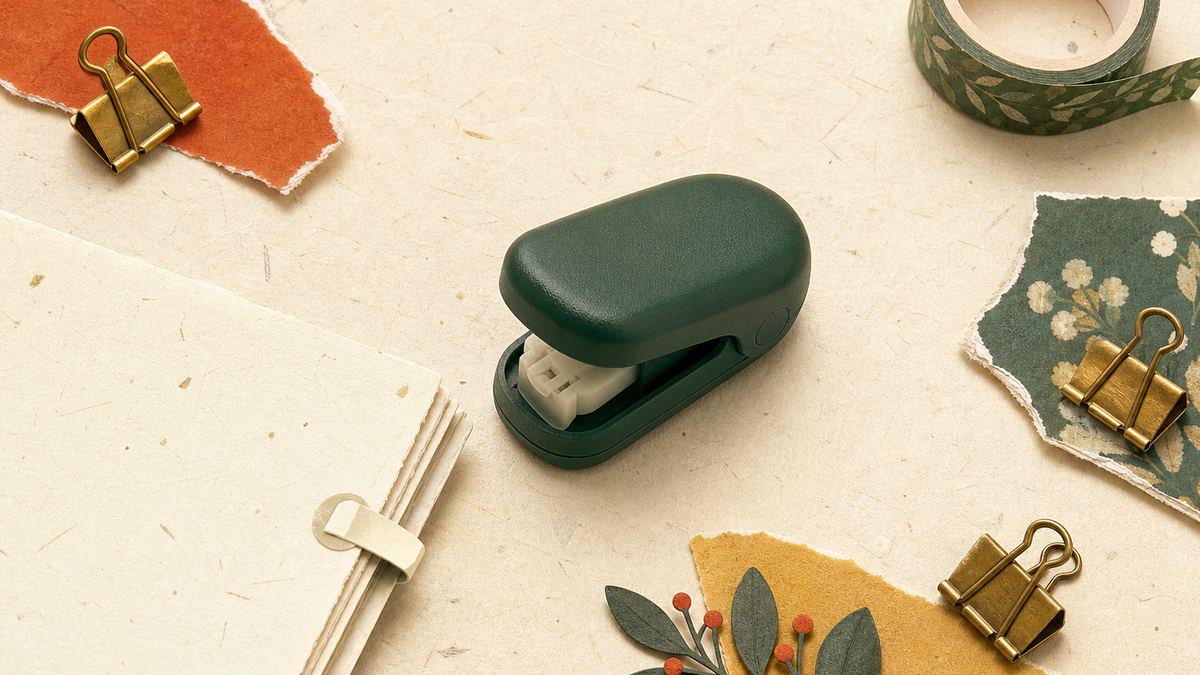
Kokuyo’s Harinacs binds a handful of pages together by cutting and folding a small tab of the paper itself into a locking slit — no metal staple at all — and the appeal isn’t novelty, it’s solving three real, specific annoyances that traditional staples cause. This is a genuinely functional design, not a gimmick product that happens to be popular because it’s Japanese and unusual.
The three real problems it solves
- Recycling. Stapled paper technically needs the staple removed before recycling in many systems; Harinacs-bound paper doesn’t, since there’s no metal involved at all.
- Flat stacking. A metal staple creates a small raised bump that stops papers from sitting perfectly flat when stacked, which compounds annoyingly across a thick stack of documents. A paper-fold binding sits nearly flush.
- Injury and snagging risk. No exposed metal point means no risk of a staple scratching a hand, snagging fabric, or (for anyone who’s had it happen) jamming painfully into a finger while flipping through papers.
How it actually works mechanically
Kokuyo Harinacs uses a punch-and-fold mechanism: pressing the handle cuts a small slit pattern through the stacked pages, then folds the resulting paper tab back through itself to lock the pages together — mechanically similar in concept to how some no-staple paper clips work, but built into a single-action handheld tool rather than requiring a separate clip.
The real limitation worth knowing upfront
Paper-fold binding is measurably less strong than a metal staple and works reliably only up to a limited sheet count (commonly around 5 sheets for compact models, up to around 10-12 for larger desktop versions). For a permanent, heavy-duty bind of a large document, a standard stapler is still the more reliable tool — Harinacs is a genuine upgrade for everyday light stapling, not a universal replacement for every stapling use case.
Who actually benefits from switching
- Anyone regularly stapling and later recycling documents — the removed step of pulling staples before recycling adds up over repeated use
- Anyone working with a stack of stapled documents that need to sit flat — filing, printing, or presentation contexts where the small staple bump is a recurring minor annoyance
- Anyone who’s had a staple-related paper cut or fabric snag — a small but real safety upgrade for handling stapled paper frequently
FAQ: Kokuyo Harinacs stapleless stapler
How many sheets can a stapleless stapler actually bind? It varies by model — compact handheld versions typically handle around 5 sheets, while larger desktop models manage up to 10-12. Check the specific product’s rated capacity before relying on it for a particular document size.
Is the paper-fold bind as strong as a metal staple? No — it’s measurably weaker and can come apart with enough handling or a thick stack. It’s well suited to everyday light stapling, not permanent heavy-duty binding.
Does this actually help with recycling? Yes, genuinely — paper bound without a metal staple doesn’t require the staple to be removed before recycling in systems where that’s required, which is a real, if modest, convenience.
Is Harinacs meant to fully replace a standard stapler? Not necessarily — it’s a strong choice for everyday light binding, but a standard stapler remains more reliable for larger stacks or documents that need a genuinely permanent, strong bind.