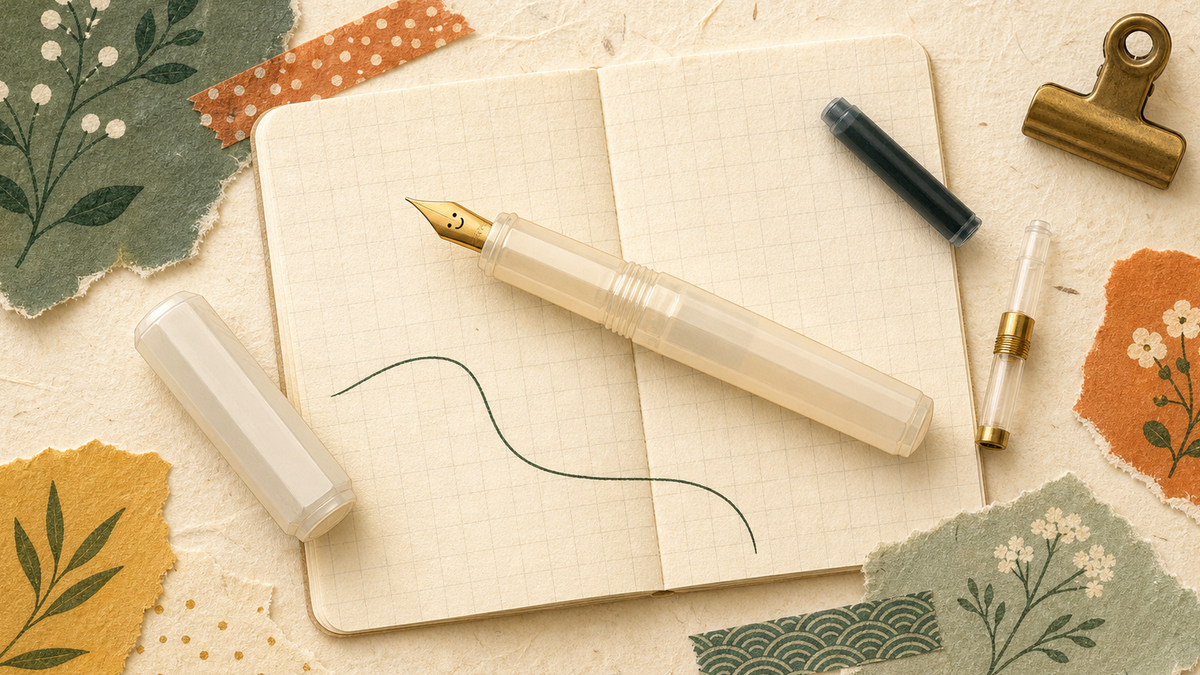
The smiley face on a Pilot Kakuno’s nib isn’t decoration — it’s a functional visual cue showing correct pen orientation, which matters because fountain pens (unlike ballpoints) write correctly only at a specific angle. This single design detail is representative of the whole pen: the Kakuno was built specifically to solve first-timer problems, not scaled down from an adult fountain pen design, which is why it’s the most commonly recommended true starter fountain pen rather than just the cheapest one available.
The hexagonal barrel — solving a problem you don’t know you’ll have yet
A common first-fountain-pen frustration is an unfamiliar grip angle relative to a ballpoint — fountain pens generally need a more consistent, lighter angle to write smoothly. The Kakuno’s hexagonal barrel naturally guides fingers into a consistent grip position and resists rolling off a desk, both genuinely practical solutions to problems a total beginner wouldn’t necessarily anticipate needing solved.
Ink system: cartridge or converter
Pilot Kakuno uses Pilot’s proprietary ink cartridges by default — the simplest option for a true beginner, since it involves no filling process at all. An optional converter (sold separately) allows switching to bottled ink later, once you know you’ll stick with fountain pens and want access to the much wider range of bottled ink colors that cartridges alone don’t offer. Starting with cartridges and adding a converter later is the sensible default order, not something to solve on day one.
Nib size — what to actually pick as a first choice
Kakuno is available in Extra Fine, Fine, and Medium nibs. Fine is the most commonly recommended starting point for English/Latin-alphabet handwriting — Medium can feel notably broader than expected for someone used to ballpoint pens, and Extra Fine, while precise, demands slightly more consistent technique that a first-time user hasn’t developed yet.
What using a fountain pen actually requires (and doesn’t)
A fountain pen needs less downward pressure than a ballpoint or gel pen — pressing hard the way you would with a ballpoint can actually cause skipping or scratchiness rather than better ink flow. This is the single biggest adjustment for someone new to fountain pens, and it’s worth knowing in advance rather than assuming a “bad” first pen when the issue is actually pressure and angle habits carried over from other pen types.
FAQ: Pilot Kakuno fountain pens
What nib size should a beginner choose? Fine is the most commonly recommended starting point for English handwriting — a reasonable balance between line precision and forgiving technique requirements.
Do I need to buy a converter to use bottled ink? Not initially — the Kakuno works out of the box with Pilot’s ink cartridges. A converter (sold separately) is only needed if you later want to use bottled ink instead.
Why does the Kakuno have a smiley face on the nib? It’s a functional design element showing correct pen orientation — fountain pens need a specific writing angle to flow smoothly, unlike ballpoint pens, and the smiley face gives a clear visual cue for that angle.
Is a fountain pen harder to write with than a regular pen? It requires an adjustment (lighter pressure, more consistent angle) rather than being inherently harder. Most of the initial “this feels wrong” experience resolves once pressure habits from ballpoint pens are unlearned.