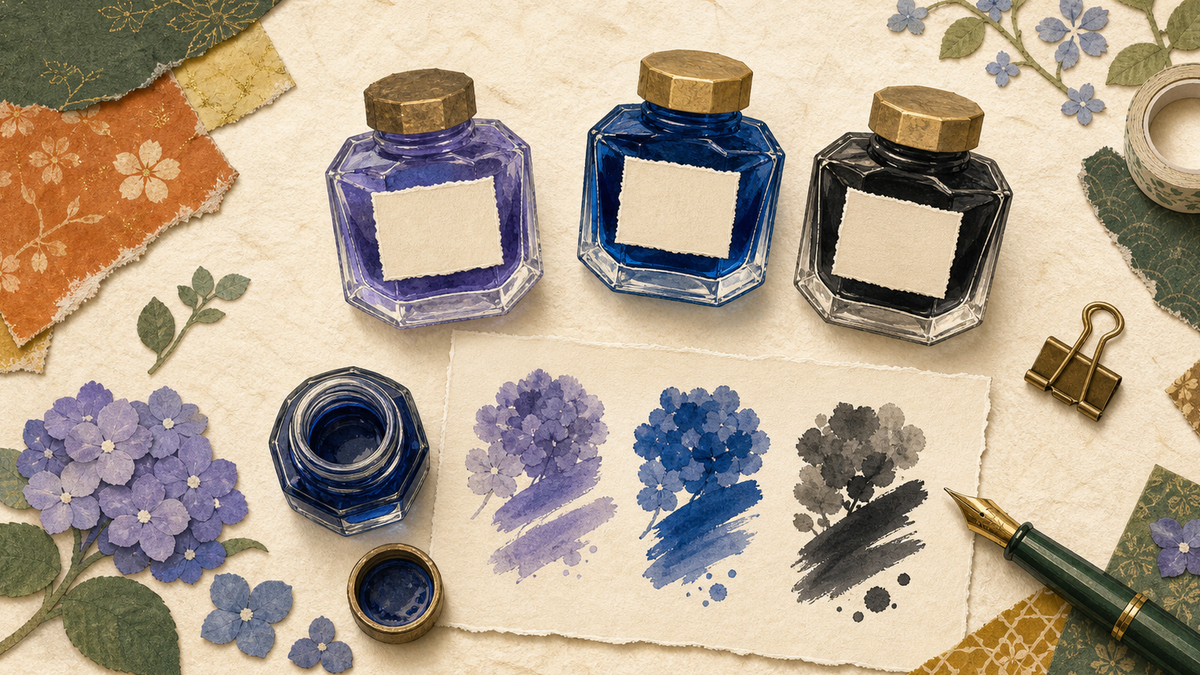
Pilot’s Iroshizuku ink line names its 24 colors after specific, evocative natural imagery — Ajisai (hydrangea), Tsuki-yo (moonlight), Take-sumi (bamboo charcoal) — rather than generic marketing labels like “Navy” or “Forest Green,” and this naming approach is actually functional: it’s easier to picture a specific hydrangea blue-purple than to guess what a brand’s arbitrary “Blue #4” looks like. Once you know a handful of the naming logic, browsing the line becomes far more intuitive than a typical ink lineup’s alphanumeric or generic color names.
Where to start if you’re new to bottled ink
Committing to a 50ml bottle of a single color is a real investment if you’re not sure fountain pens (or a specific color) will stick as a habit. Pilot Iroshizuku Mini 3-color sets — 15ml bottles instead of the full 50ml — are the sensible starting point, letting you try a few colors before committing to a full bottle of any single shade.
A few well-known colors worth knowing by name
- Ajisai (Hydrangea) — a blue-purple that’s one of the more popular colors in the line, often recommended as a first bottle
- Take-sumi (Bamboo Charcoal) — a genuine black, useful as a standard daily-writing option alongside more expressive colors
- Kon-peki (Deep Azure Blue) — a saturated blue that’s a common pick for anyone wanting a standard “blue ink” that’s more vivid than a typical ballpoint blue
Why the glass bottle design isn’t just aesthetic
Each Iroshizuku bottle is individually made from hand-blown glass with a design intended to make the last bit of ink easier to draw up into a pen’s converter — a real practical detail, not purely decorative packaging, that matters once a bottle starts running low and shallow ink becomes harder to reach with a standard converter.
What you need to actually use bottled ink
Bottled ink requires a fountain pen that accepts a converter (a refillable ink chamber) rather than being cartridge-only — worth checking before buying a bottle. A pen like the Pilot Kakuno can use bottled ink once fitted with the optional converter, making it a reasonable pairing for a first bottle of Iroshizuku.
FAQ: Pilot Iroshizuku ink
Do I need a special pen to use Iroshizuku ink? You need a fountain pen that accepts a converter (or an eyedropper-fillable pen) rather than one restricted to proprietary cartridges. Many beginner fountain pens, including the Kakuno, support this with an optional converter.
What’s a good first color to try? Ajisai (a blue-purple hydrangea shade) is one of the most commonly recommended starting colors, alongside Take-sumi for a standard black option.
Are the 15ml mini bottles worth it over a full 50ml bottle? Yes, especially as a first purchase — they let you try multiple colors at lower cost and risk before committing to a full bottle of any single shade you’re unsure about.
Does the ink color name actually match what the ink looks like? Generally yes — the naming is deliberately tied to specific, recognizable natural imagery (a particular flower, a natural phenomenon) rather than abstract branding, which makes the connection between name and actual color more intuitive than typical ink naming.