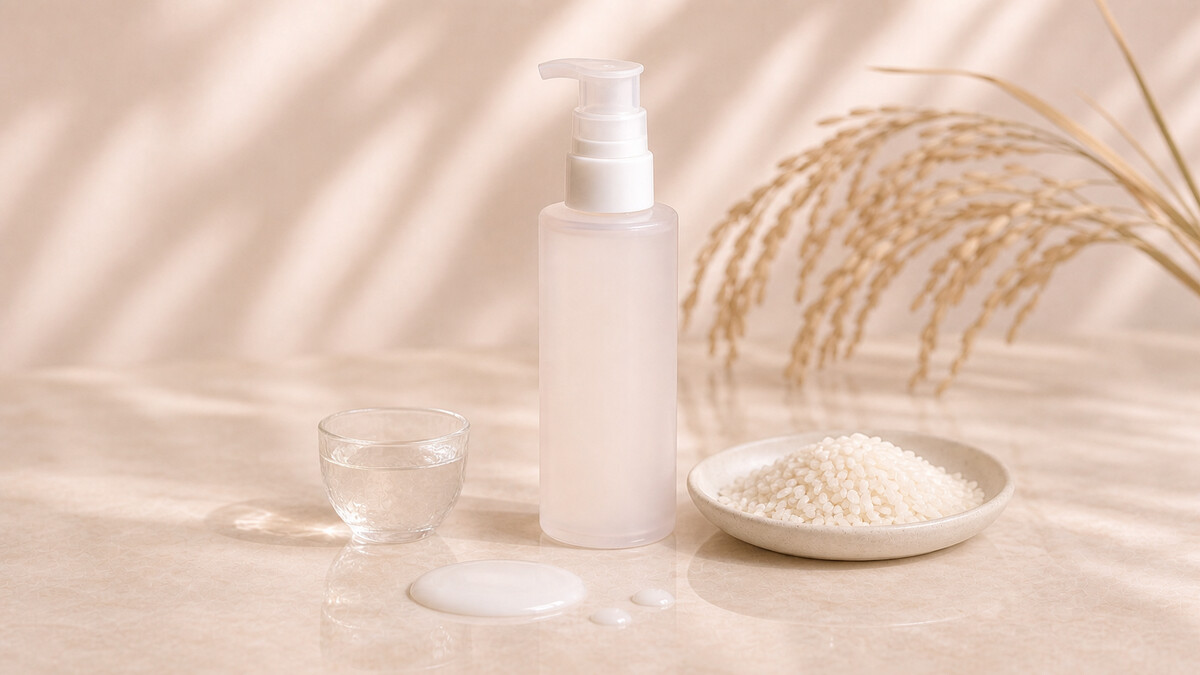
The observation behind sake-based skincare is a real one, not just a folk story: sake brewers who handle fermenting rice daily have long been noted for unusually smooth hands, and the mechanism is fermentation byproducts — amino acids, kojic acid, and other compounds produced during rice fermentation — that have genuine skin-brightening and moisturizing properties. SK-II’s origin story (covered in our Pitera essence guide) is the most famous version of this, but sake-and-rice skincare is a broader category in Japan, not one brand’s marketing angle.
What fermentation actually does to rice
Sake fermentation breaks down rice starches and proteins into smaller, more bioavailable compounds — amino acids, peptides, and organic acids — many of which have documented humectant (moisture-attracting) or brightening properties on skin. This is the same general principle behind fermented skincare ingredients more broadly (including Pitera), just expressed through a different fermentation process specific to sake brewing.
Kikumasamune — sake maker turned skincare brand
Kikumasamune is a genuine sake brewery that extended into skincare specifically because of this brewer’s-hands observation, rather than a skincare brand adopting “sake” as a marketing ingredient after the fact. Their Sake Rice Face Wash and Sake Moisturizing Cream both build on sake rice extract combined with ceramides and amino acids, positioned as accessible, mid-range entry points into this category rather than a premium specialty line.
Is this actually different from regular fermented skincare?
Fermented ingredients broadly (including non-sake fermentation) share some of the same benefits — this isn’t a claim that sake specifically is uniquely superior to all other fermentation-based skincare. What sake-specific products offer is a well-documented, culturally rooted version of the same underlying fermentation science, with genuine brand heritage (an actual sake brewery, not a marketing story) behind at least some of the options available.
Who this fits
Rice-and-sake skincare tends to suit people looking for a gentler entry point into fermented skincare than a premium option like SK-II — Kikumasamune’s price point is meaningfully lower, making it a reasonable way to test whether fermented ingredients work well for your skin before considering a bigger investment.
FAQ: Sake and rice skincare
Is sake skincare actually backed by anything, or just a marketing story? The underlying mechanism is real — rice fermentation produces amino acids and other compounds with documented moisturizing and brightening properties on skin. The “sake brewers have smooth hands” observation is a genuine, long-standing one, not an invented origin story.
Is Kikumasamune the same as SK-II? No — they’re different companies with different formulations, though both are built on the same general fermented-rice/sake principle. Kikumasamune is positioned at a more accessible price point.
Does sake skincare contain actual alcohol? The products use rice fermentation extracts (sake kasu or similar), not beverage-grade alcohol as an ingredient — the fermentation byproducts are the active component, not alcohol content itself.
Is this a good starting point for trying fermented skincare? Yes — it’s a reasonable, lower-cost way to test whether fermented ingredients suit your skin before considering a more expensive product like SK-II’s Pitera essence.