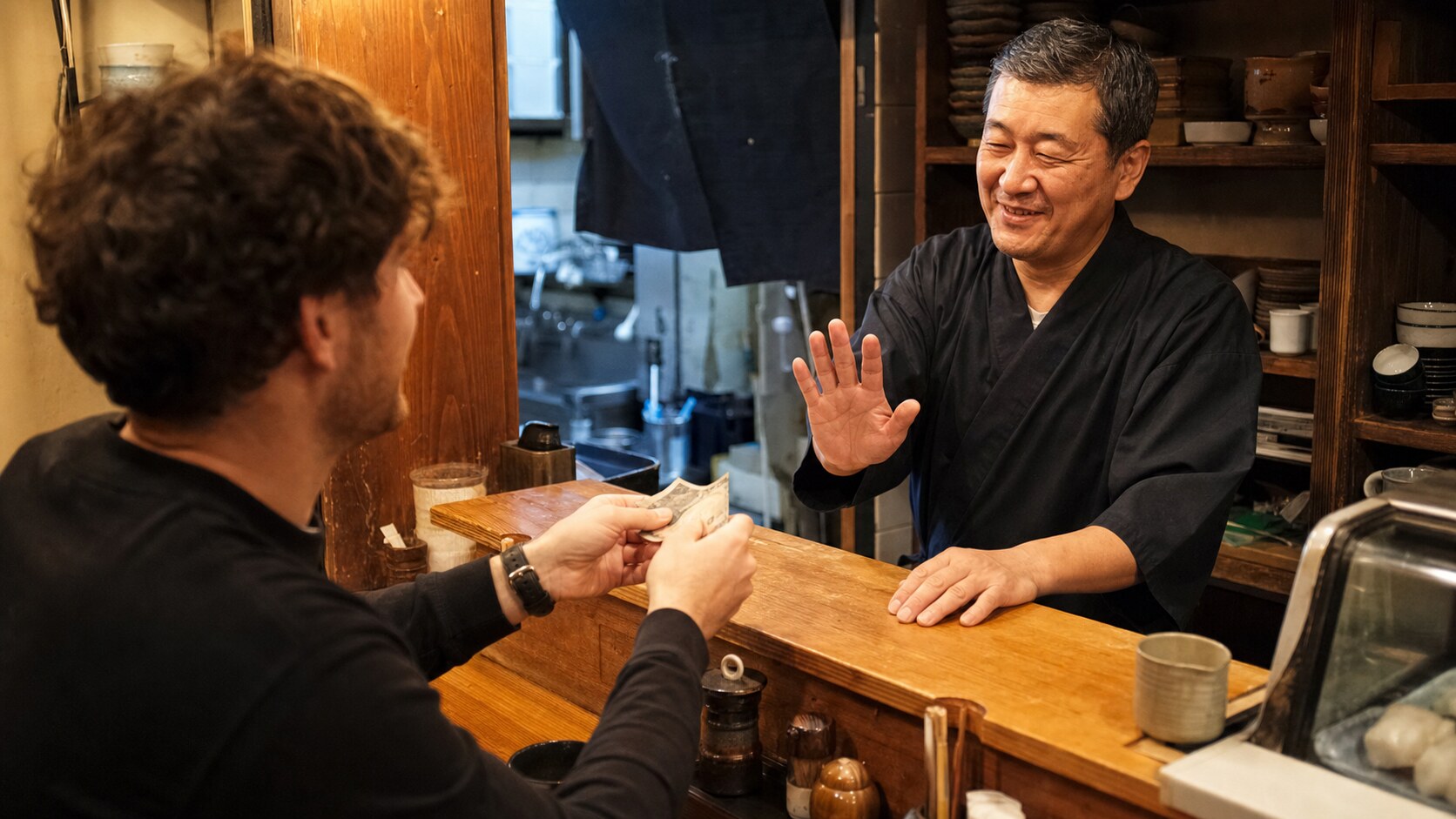
Don’t tip in Japan — not at restaurants, not in taxis, not at hotels. This isn’t a soft cultural preference where tipping is merely unusual; attempting to tip frequently results in the money being politely handed back, on the assumption that you’ve either miscounted your change or misunderstood how payment works here. Good service is considered already included in the price, not something purchased separately with an extra payment on top.
Why tipping isn’t part of the system
The underlying idea is straightforward: excellent service is the baseline standard, not an upgrade you pay extra for. Staff are paid appropriately for the job as-is, and offering more money on top of the bill can come across as implying the standard service wasn’t already sufficient — which is closer to insulting than generous in this context.
What actually happens if you try
In the best case, a server or driver politely declines and hands the money back with a smile. In the more awkward version, they assume you’ve made a mistake — miscounted change, misread a menu price — and will sometimes come after you outside to return what they see as an error. Neither outcome is what a well-meaning tip is going for, which is exactly why it’s simpler to just not offer one.
The one real exception: service charges
Some upscale restaurants and hotels build a service charge (typically 10–15%) directly into the bill — this is different from tipping, is not optional, and is already reflected in the total you’re shown. It’s worth glancing at a bill or menu for this at higher-end establishments, but it requires no action on your part; it’s calculated automatically, not something you add yourself.
If you genuinely want to show appreciation
A sincere verbal thank-you (“gochisousama deshita” after a meal, roughly “thank you for the meal,” is a small, well-received phrase) goes further than money here. For a ryokan stay, a small gift (a kokorozuke, traditionally a modest cash gift presented in an envelope at check-in rather than as payment for service rendered) is a genuine but different-in-spirit exception — and even this is optional, regional, and not expected from foreign visitors.
FAQ: Tipping in Japan
Is it rude to tip in Japan? It’s not exactly rude, but it’s unnecessary and often creates an awkward moment, since staff frequently interpret it as a mistake and try to return the money rather than accept it as a gift.
Do taxi drivers expect a tip in Japan? No — the meter fare is the full expected payment. Rounding up slightly is not customary and drivers will typically try to give back what they see as excess change.
What about service charges at restaurants and hotels? Some upscale establishments include a 10–15% service charge directly in the bill. This isn’t a tip you add — it’s already calculated into the total shown, and no additional payment is expected.
Is there any tipping-adjacent custom in Japan? The closest equivalent is a kokorozuke — a small cash gift sometimes given to ryokan staff at check-in as a gesture of goodwill, presented in an envelope rather than handed over directly. It’s optional and not expected from tourists.