
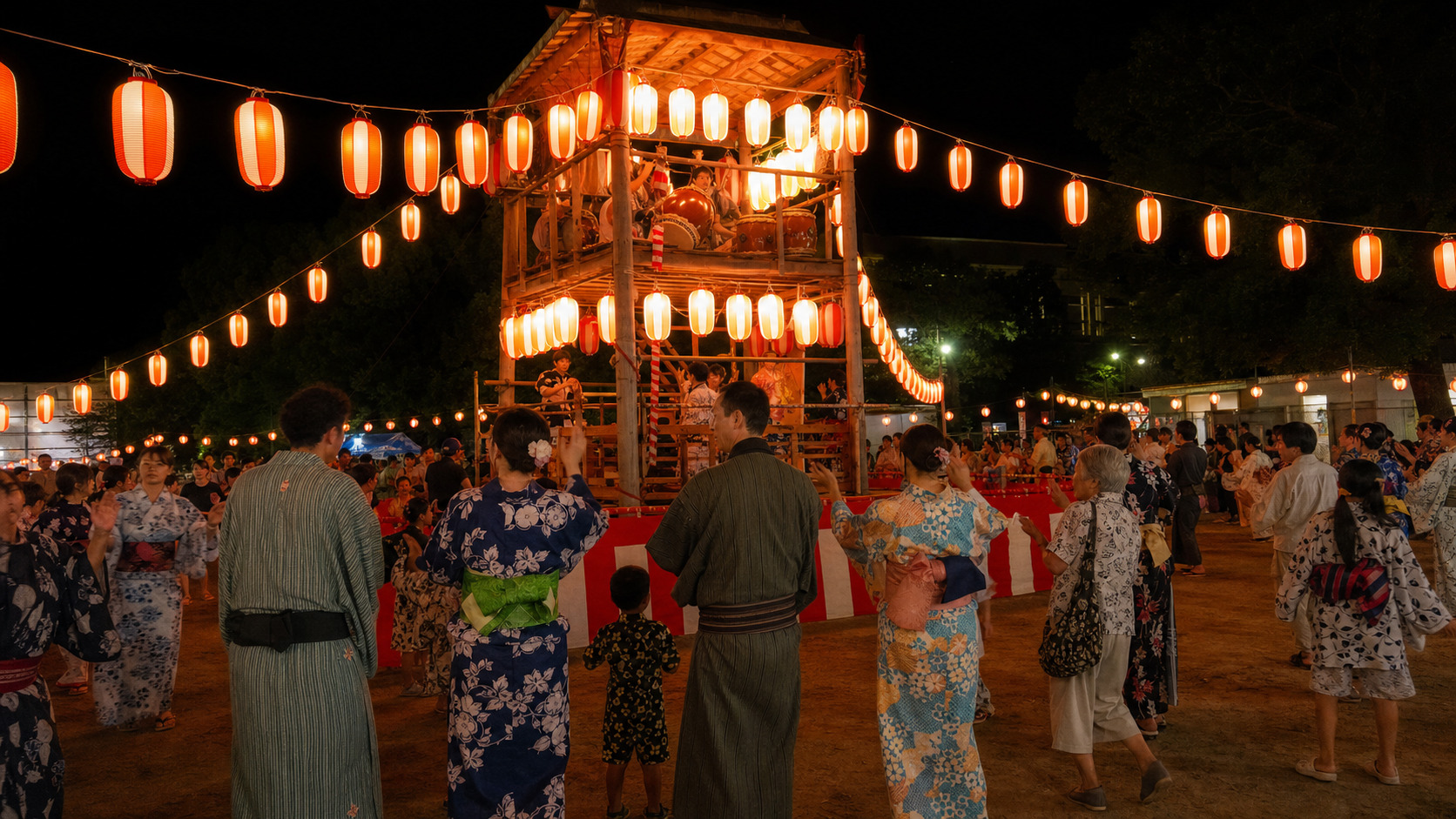
Obon is a Buddhist festival honoring ancestral spirits, observed by most of Japan around August 13–16 (Tokyo follows an older July calendar instead), and its most visitor-friendly part is Bon Odori — free, open-air community dance events held nightly around a central wooden tower (yagura) throughout July and August. The dance steps are simple, repeat in a loop, and are picked up in a song or two just by copying the people in front of you; no prior knowledge or registration is needed to join in.
For a few days in mid-August, Japan quietly turns inward. Trains empty out of the big cities, family homes fill up, and in nearly every neighborhood, town square, and shrine courtyard, a wooden tower goes up in the middle of a circle of paper lanterns. This is Obon — one of the most important, and most visually striking, traditions in the Japanese calendar.
What Obon actually is
Obon is a Buddhist tradition centered on honoring the spirits of ancestors, who are believed to return home for a few days each summer. Families visit and clean grave sites, light lanterns to guide spirits back, and at the end of the festival, send them off again — sometimes literally, by floating lit lanterns down a river (a ceremony called toro nagashi).
Dates vary by region. Most of Japan observes Obon around August 13–16, though Tokyo and a few areas follow an older July calendar instead. If you’re planning a trip around Obon, check the specific city you’re visiting rather than assuming a fixed date.
The observance dates are not the whole story for transport. In 2026, the busiest travel window begins on August 7; our Obon 2026 travel guide explains the peak days, Shinkansen restrictions, and the easiest dates to move between cities.
Bon Odori: the part everyone can join
There’s a particular kind of travel moment that doesn’t come from a ticketed attraction: standing in a circle of strangers, moving through the same simple steps as everyone around you, with no stage separating you from the event. That’s Bon Odori. The most visible, most photographed piece of Obon is community dance events held in parks, shrine grounds, and even shopping street parking lots throughout the season. A wooden scaffold (yagura) is built in the center, taiko drummers and singers perform from the top, and everyone else dances in loose concentric circles around it.
The choreography is simple by design and repeats in a loop, so newcomers pick it up within a song or two just by copying the people in front of them — no lessons, no rehearsal, no risk of standing out for the wrong reasons. Nobody expects visitors to know the steps in advance, and standing at the edge watching for a few minutes before joining is completely normal.
Most Bon Odori events are free, open-air, and genuinely local — expect food stalls, kids in yukata, and an atmosphere closer to a neighborhood block party than a staged tourist event.
Where to see it
The version of this festival worth seeking out isn’t the biggest one — it’s the one that still feels like a neighborhood gathering rather than a show for outsiders. A few options deliver that, depending on how local you want the experience to feel:
- Tokyo — smaller neighborhood Bon Odori events pop up throughout the city in July and August; larger ones happen at temples like Tsukiji Hongwanji
- Kyoto — the Gozan no Okuribi (the famous mountainside bonfires spelling out characters like 大) closes out Obon on August 16 and draws crowds along the Kamo River
- Regional festivals — some of the largest and most elaborate Bon Odori traditions happen outside the major cities entirely, in towns where the dance has been passed down with distinct local steps and music for generations
Practical notes
- What to wear: A yukata isn’t required, but it’s common, comfortable in the heat, and easy to rent for the evening near most festival sites
- When to arrive: Dancing typically starts at dusk and runs for a few hours; arriving early gets you a better view of the yagura and first pick of food stalls
- Photography: Bon Odori is one of the most welcoming festivals for photography — dancers are generally happy to be photographed, though asking first is still good etiquette, especially for close-up portraits
Worth building a trip around?
If your dates line up with mid-August, yes — Obon offers something a lot of curated tourist experiences can’t: an actual slice of community life, unstaged and running exactly as it has for decades. Pair a Bon Odori evening with Kyoto’s Gozan no Okuribi bonfires a few days later, and you’ve got one of the more meaningful ways to experience a Japanese summer.
FAQ: Obon and Bon Odori
When is Obon in Japan? Most of Japan observes Obon around August 13–16, though Tokyo and some areas follow an older July calendar. Check the specific city you’re visiting rather than assuming a fixed date.
Do I need to know how to dance to join Bon Odori? No. The choreography is simple by design, repeats in a loop, and most visitors pick it up within a song or two just by copying the people dancing in front of them.
Is Bon Odori free to attend? Yes, most Bon Odori events are free and open-air, held in parks, shrine grounds, and shopping street parking lots throughout July and August.
What should I wear to a Bon Odori festival? A yukata isn’t required but is common and easy to rent near most festival sites; regular summer clothing is completely fine too.
Where can I see Obon traditions in Kyoto specifically? The Gozan no Okuribi mountainside bonfires on August 16 close out Obon in Kyoto and draw crowds along the Kamo River, pairing well with a Bon Odori evening earlier in the week.
Will Obon affect trains and travel in Japan? Yes. The cultural observance is mostly August 13–16, but the 2026 transport rush runs August 7–16. Avoid long-distance travel on August 8 and 16 if possible, and read our day-by-day Obon travel advice before booking a Shinkansen.