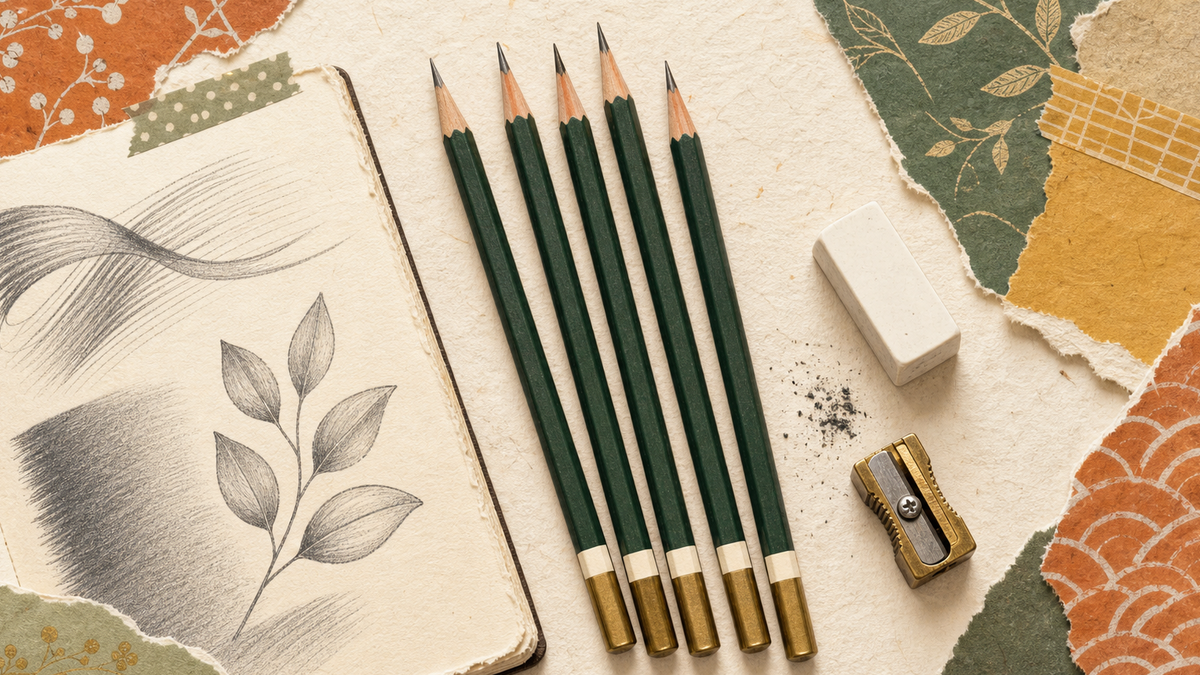
The Tombow Mono 100 has a following among professional illustrators, drafters, and designers that goes well beyond typical stationery enthusiasm — and the reason is a genuinely high-density graphite formulation, not branding. Tombow markets the core technology as producing an unusually smooth line with fine, consistent particle structure, which translates in practice to less graphite dust, cleaner shading, and a noticeably smoother feel than a standard pencil at a similar price.
What “high-density structure” actually means for how it draws
Standard pencil graphite has a coarser, more variable particle structure, which is part of why cheaper pencils can feel scratchy or leave more visible texture in shaded areas. The Mono 100’s finer, denser graphite composition lays down a smoother, more even line and blends more cleanly when shading — a real, feelable difference for anyone doing detailed drawing or drafting work, not just a marketing claim.
The hardness range, and why it matters more than with a typical pencil
Like most graphite pencils, the Mono 100 comes in a hardness range from very hard (used for fine technical lines) to very soft (used for rich, dark shading) — Tombow Mono 100 HB pencils are the standard middle-ground starting point, while Tombow Mono 100 4B sits toward the softer, darker end favored for sketching and shading work. Because the graphite quality is higher across the entire range, the difference between grades is more consistent and predictable than with a budget pencil line — professionals often build a full set specifically because each grade performs reliably as expected.
Who actually needs this vs. who’s fine with a standard pencil
- Illustrators, architects, and drafters doing precision line work or extensive shading get a genuine, measurable benefit from the smoother, finer graphite
- Students and casual note-takers are unlikely to notice enough difference to justify the price premium over a standard HB pencil — this isn’t a pencil that makes everyday handwriting meaningfully better
- Anyone building an art or drafting toolkit benefits from starting with a small range of grades (HB, 2B, 4B is a reasonable starting spread) rather than buying the full extended range upfront
A quality signal worth knowing
The Mono 100’s wood casing and finish are also higher-grade than typical pencils, which shows up in things like consistent sharpening and reduced lead breakage — a smaller but real quality difference that compounds with heavy daily use in a way that’s easy to underrate until you’ve used a lower-quality pencil that breaks constantly under a sharpener.
FAQ: Tombow Mono 100
Is the Tombow Mono 100 worth it for casual note-taking? Not particularly — the quality advantages are most noticeable in detailed drawing, shading, and drafting work. For everyday handwriting, a standard pencil performs similarly enough that the price premium isn’t clearly justified.
What hardness grade should a beginner start with? HB is the standard, versatile starting point. If sketching or shading is the goal specifically, adding a 2B or 4B to the starting set covers most common needs.
Is Mono 100 significantly better than a standard Tombow pencil? Yes, in terms of graphite smoothness and consistency — it’s a genuinely higher tier within Tombow’s own lineup, not just a premium-priced version of the same core product.
Does the higher graphite quality actually reduce smudging? The finer particle structure tends to produce cleaner shading with less visible graphite dust compared to coarser standard graphite, which many users report as a real, noticeable difference in detailed work.