
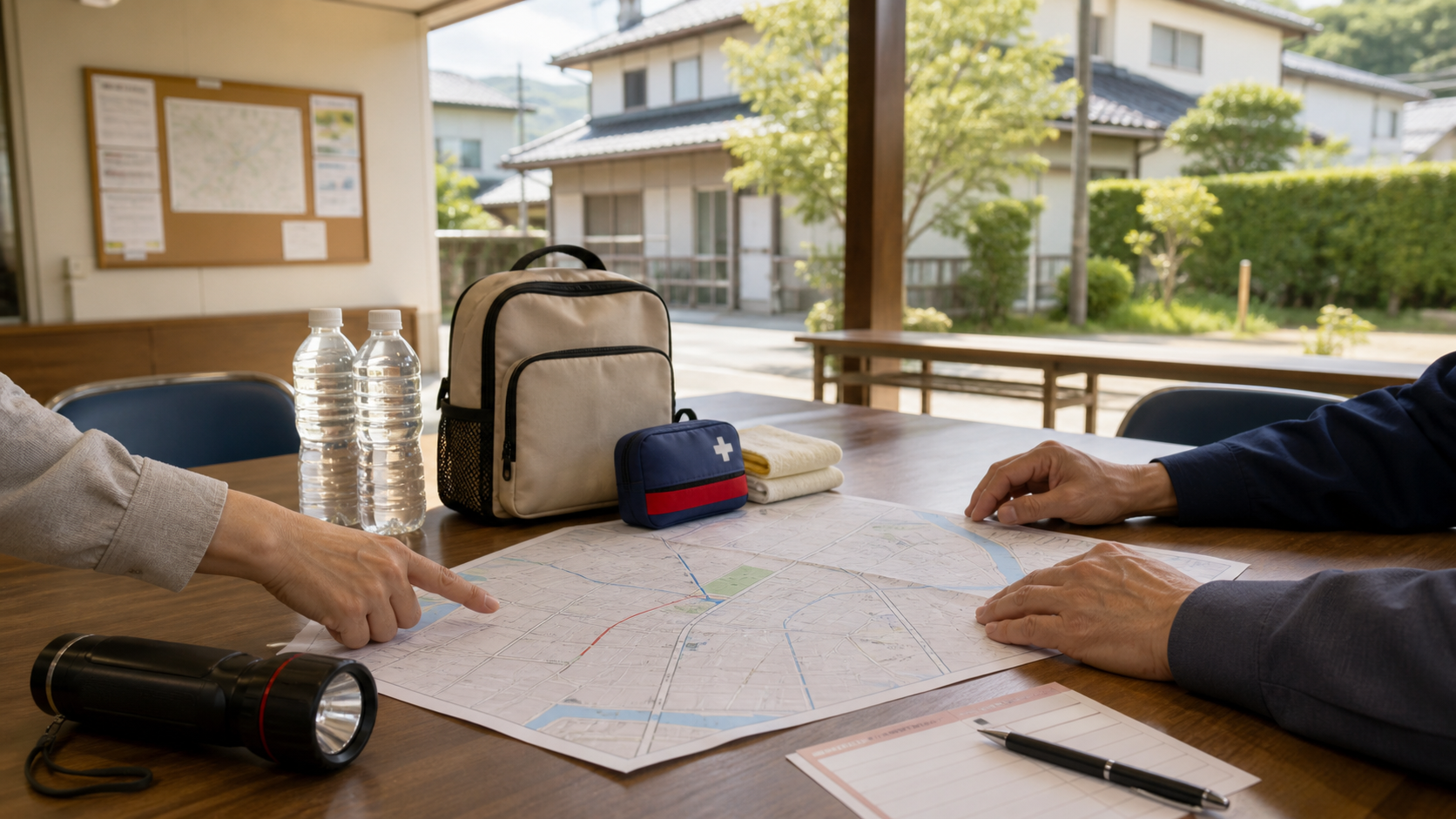
September 1 is Japan’s Disaster Preparedness Day, and its practical purpose is to turn local evacuation routes, family communication, and emergency supplies into a plan before an emergency.
The date is more than a school-calendar event. Japan’s Fire and Disaster Management Agency describes September 1 as Disaster Preparedness Day and August 30 through September 5 as Disaster Preparedness Week. During these periods, communities and organizations hold drills and review what to do before and after an earthquake or other disaster.
From a date to a plan
The official guidance focuses on actions that are easier to take when they have been discussed in advance: learning about local risks, agreeing where family members will meet, deciding how to communicate, checking evacuation routes, preparing supplies, and taking part in neighborhood activities.
The aim is not to predict every detail of a future disaster. It is to reduce the number of decisions people must make for the first time while stressed. A short conversation about a meeting place can be useful even if the family never needs to use the plan.
Why drills use maps and scenarios
Some Japanese preparedness activities use illustrations or maps to imagine what a neighborhood might look like after an earthquake. Participants describe possible damage and the actions needed to restore safety. This turns a vague fear into a set of practical questions:
- Which route is still usable if a road is blocked?
- Where would family members be if the earthquake happened during the day?
- Who might need help reaching a safer place?
- What would be difficult if electricity or mobile networks were unavailable?
The answers are local. A coastal area, a mountain community, and a dense urban neighborhood do not face exactly the same hazards, so the most useful plan comes from the municipality and the building or neighborhood where you actually are.
Three things to check before September 1
| Check | A useful question |
|---|---|
| Route | Where is the official evacuation area, and which route avoids obvious hazards? |
| Contact | How will family members communicate if mobile networks are congested? |
| Supplies | Where are water, food, lights, medication, and essential documents? |
For visitors, the same principle applies on a smaller scale. Know the emergency information provided by your hotel, check the local government’s evacuation guidance, and keep your phone charged. Follow official instructions if an emergency occurs; a general article cannot replace local warnings.
The role of earthquake early warnings
Japan’s Meteorological Agency explains that the Earthquake Early Warning system provides an advance announcement of estimated seismic intensity and the expected arrival time of the main shaking. The goal is to give people and systems a chance to take protective action when possible.
There are important limits. The available time can be very short, and places close to the earthquake’s focus may receive an alert only just before strong shaking or after it begins. An alert is therefore not a promise of a long warning. It is one part of a wider plan that includes knowing your surroundings and following official evacuation information.
Preparedness is local
Japan’s Disaster Preparedness Day can look like a national ritual, but the useful part is specific: this building, this family, this neighborhood, and this route. Check the municipality’s disaster map and the instructions from your accommodation or workplace rather than relying on a generic list.
The goal is not to make a trip feel frightening. It is to make one or two important actions familiar before they are urgently needed. Preparedness works best as a quiet routine.
FAQ: Disaster Preparedness Day in Japan
When is Japan’s Disaster Preparedness Day?
It is September 1. The Fire and Disaster Management Agency describes August 30 through September 5 as Disaster Preparedness Week.
Do all residents attend the same drill?
No. Activities vary by municipality, neighborhood, school, workplace, and organization. Check with the local government or community group for details.
Does an earthquake early warning always arrive before the shaking?
No. The warning system has limitations, and areas close to the source may have little or no advance time. Protect yourself according to your surroundings and follow official information.
What should a traveler do during an earthquake in Japan?
Follow instructions from the hotel, station, transport operator, or local authorities. Move away from immediate hazards, do not rush toward crowded exits, and check official updates before deciding where to go next.
Sources
- Fire and Disaster Management Agency, Disaster Preparedness Activities
- Japan Meteorological Agency, Monitoring of Earthquakes, Tsunamis and Volcanic Activity
- Japan Meteorological Agency, Earthquake Early Warning System