
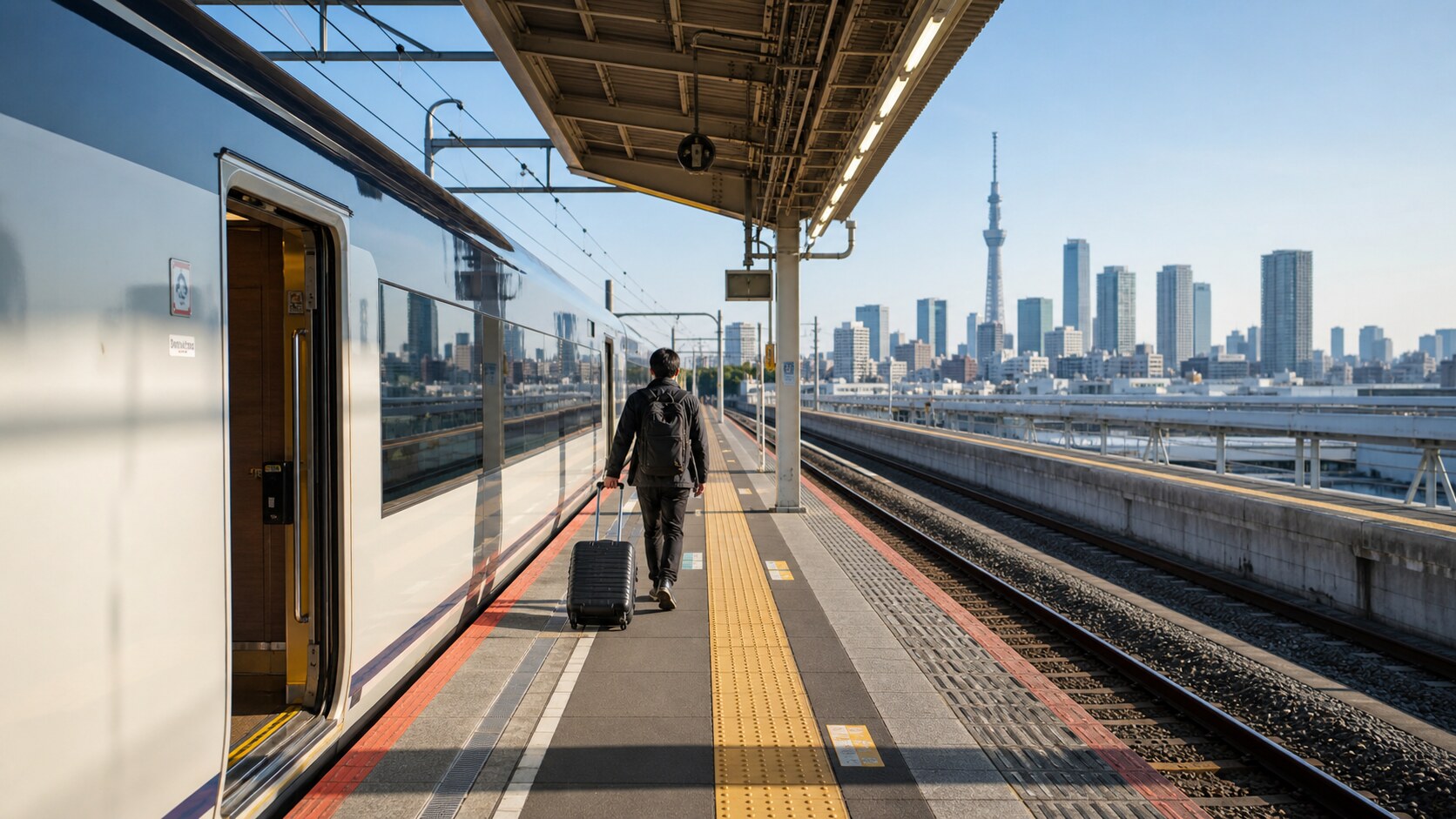
You do not need to understand every Japanese train announcement: listen for the line, destination, delay, and transfer words, then confirm the details on a display or the operator’s official service page.
Japanese station announcements can sound impossibly fast when you are carrying luggage and trying to find the right platform. They are usually repeating a small set of practical details, though: what train is arriving, where it is going, what has changed, and what passengers should do next.
The four details worth catching first
When an announcement begins, do not try to translate every word. Look for these details in order:
| Detail | What it answers | Where to confirm it |
|---|---|---|
| Line and destination | Is this your route and direction? | Platform display and route map |
| Train type | Does it stop at your station? | Train display and timetable |
| Platform or track | Where should you stand? | Number signs and floor markings |
| Service change | Is there a delay, suspension, or alternate route? | Operator app, website, or station staff |
The announcement is only one part of the information system. Major operators also provide electronic signs, route maps, service-status pages, and announcements in multiple languages. Use the sound to notice a change, then use the written information to make the decision.
Japanese words you will hear often
These words are more useful than memorizing a complete announcement.
| Japanese | Reading | Practical meaning |
|---|---|---|
| まもなく | mamonaku | Soon; a train or event is about to happen |
| 番線 | bansen | Platform or track number |
| 各駅停車 | kakueki-teisha | Local train; stops at every station on that service |
| 急行 | kyūkō | Express service; stops at fewer stations |
| 遅延 | chien | Delay |
| 運転見合わせ | unten miawase | Service temporarily suspended or held |
| 運転再開 | unten saikai | Service has resumed |
| 振替輸送 | furikae yusō | Alternative transportation during a disruption |
| お乗り換え | o-norikae | Transfer or connection |
The exact stopping pattern of an express train differs by railway and time of day. Treat 急行 as a warning to check the stops, not as a guarantee that it is faster for your particular destination.
What a delay announcement is trying to tell you
There are three separate questions during a disruption:
- Is the train late, or has operation stopped?
- Is the problem limited to one train or affecting the line?
- Can you continue, wait, or use another route?
For example, 遅延 tells you that the service is delayed, while 運転見合わせ means you should not assume that the next train will arrive normally. 運転再開 means trains have started moving again, but the timetable may still be recovering.
Do not assume that 振替輸送 means any route is automatically free. The eligibility and instructions depend on the railway operators and your ticket. Ask station staff before passing through another company’s gates if the announcement tells you to use an alternate service.
Tokyo Metro gives a useful example of how operator information is organized: its English FAQ says that delays of five minutes or more, or suspensions, are announced on displays near the ticket gates in English, Chinese, and Korean. The same page points passengers to its online service information outside the station.
When you cannot hear or read the announcement
Move to a display near the ticket gates or platform entrance and check the line name, destination, and status. If the information is still unclear, show your destination on your phone to a station employee. A simple question such as この電車は○○駅に行きますか? (Does this train go to ○○ Station?) is enough.
Tokyo Metro also offers a service called Mieru Announcement. By scanning a QR code or holding a smartphone over a trigger board in the station, passengers can see station announcements as multilingual text. Availability and the way to access the service can change, so follow the signs at the station rather than looking for the feature everywhere in Japan.
If you are traveling from an airport, save your first route before leaving the terminal. Our Narita and Haneda airport transport guide explains the main options, and our Suica and Pasmo guide covers the payment card decision that often comes next.
The short version
Japanese train announcements are not a test of listening ability. They are a stream of route, status, and safety information. Learn the few disruption words above, keep the operator’s official service page available, and use station staff when the written information does not match your plan.
FAQ: Japanese train announcements
Do Japanese trains always announce information in English?
No. Many major urban operators provide English announcements or displays, but language coverage varies by railway, line, station, and situation. Check the operator’s signs and website rather than assuming every announcement will be bilingual.
What does 運転見合わせ mean?
It means train operation is temporarily suspended or held. It is stronger than a normal delay, so look for the operator’s next update before deciding whether to wait.
What does 振替輸送 mean for a visitor?
It refers to alternative transportation arranged during a service disruption. The details depend on the ticket and the participating operators. Ask staff how to use it before entering another railway’s gates.
Can I ask a station employee for help in English?
You can try. If communication is difficult, show the destination, station name, or route on your phone. Pointing to the platform display is often enough to make the question clear.
Sources
- Tokyo Metro, Where can I get information on train service and delays?
- Tokyo Metro, Mieru Announcement
- JR East, Train Status Information