
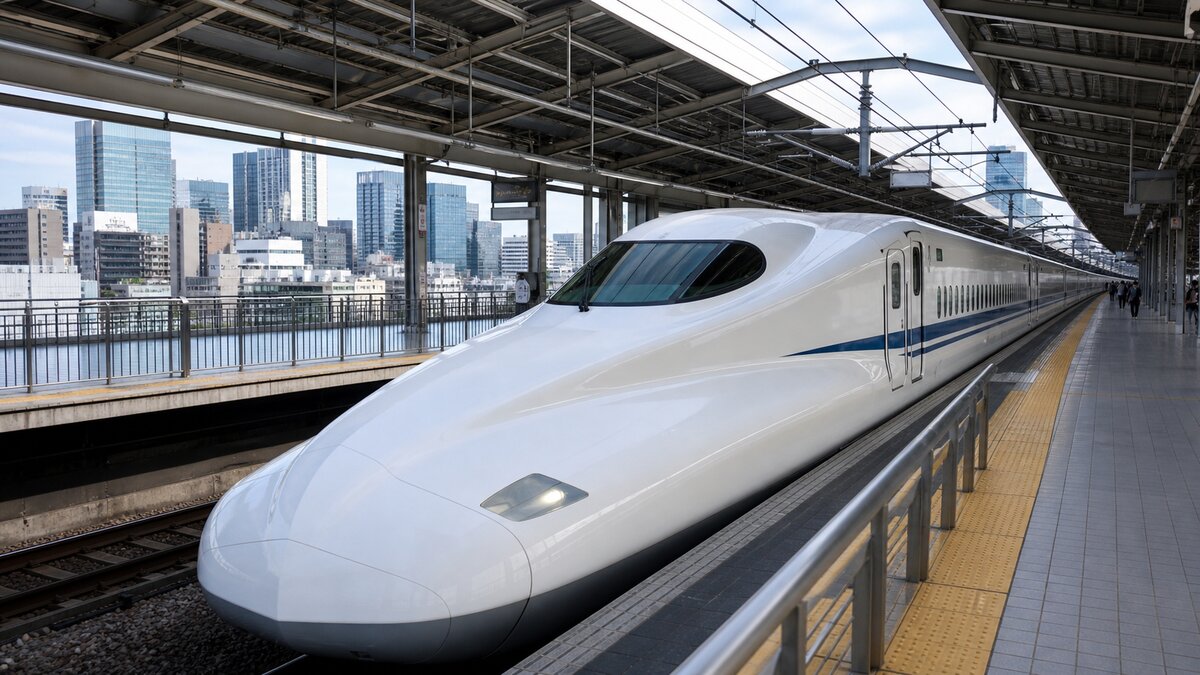
Nagoya sits almost exactly between Tokyo and Osaka on the Tokaido Shinkansen line — about 100 minutes to Tokyo and roughly 35–50 minutes to Kyoto or Osaka on the Nozomi — which makes it the only major Japanese city where both ends of the “golden route” are same-day trips. It also has its own international airport, Chubu Centrair, and a compact city center that doesn’t require the multi-hour cross-town commutes Tokyo and Osaka do. Most first-time visitors never consider Nagoya as a base. That’s less a knock on Nagoya and more a gap in how Japan trips typically get planned.
The core case: Nagoya is the actual midpoint
The Tokaido Shinkansen line runs Tokyo → Nagoya → Kyoto → Shin-Osaka in a straight line, and Nagoya is genuinely close to the middle of it — not just in a loose geographic sense, but in travel time:
| Route (fastest Nozomi service) | Approx. travel time |
|---|---|
| Tokyo → Nagoya | ~100 minutes |
| Nagoya → Kyoto | ~34 minutes |
| Nagoya → Shin-Osaka | ~49 minutes |
| Tokyo → Kyoto (reference) | ~2 hours 10–20 minutes |
| Tokyo → Shin-Osaka (reference) | ~2 hours 21–30 minutes |
The practical effect: from Tokyo, a Kyoto or Osaka day trip is a genuinely long haul — over four hours of round-trip train time before you’ve done anything. From Nagoya, both cities are closer to a one-hour trip each way. Tokyo is farther out at roughly 100 minutes, but that’s still well within a comfortable day-trip window, and closer to Tokyo than Kyoto or Osaka is from Tokyo itself.
What that looks like as a home base
| If you’re based in… | Round trip to Tokyo | Round trip to Kyoto/Osaka |
|---|---|---|
| Nagoya | ~3 hours 20 minutes | ~1 hour 10 minutes – 1 hour 40 minutes |
| Tokyo | — (you’re already there) | ~4.5–5 hours |
| Kyoto/Osaka | ~4.5–5 hours | — (you’re already there) |
This is the actual argument for Nagoya as a base, and it’s a narrow one on purpose: it’s not that Nagoya is more scenic or more famous than Tokyo or Kyoto — it’s that geometrically, no other major city lets you treat both halves of Japan’s most popular travel corridor as short excursions instead of full-day commitments.
Chubu Centrair: a real international gateway, not a regional airstrip
Chubu Centrair International Airport (NGO) opened in 2005 on an artificial island in Ise Bay and functions as central Japan’s main international gateway — it’s a full-service airport with its own set of Asian and long-haul international routes, not just a domestic feeder. It sits offshore from Nagoya proper, connected to the city by the Meitetsu Airport Line.
Getting into the city:
- Meitetsu μ-SKY Limited Express — the fastest option, reaching Meitetsu Nagoya Station in about 28–30 minutes on a reserved seat. Total fare runs around ¥1,430 (regular fare plus the reserved-seat surcharge).
- Meitetsu Limousine Bus — connects the airport directly to hotel-heavy areas like Fushimi and Sakae, useful if your accommodation isn’t near Nagoya Station itself, though it takes longer (roughly 50 minutes to over an hour depending on traffic and stop).
Landing at Centrair instead of Narita or Haneda cuts out an entire leg of most itineraries: rather than flying into Tokyo and then taking a 100-minute Shinkansen ride just to reach your base, you land close to where you’re staying.
Practical transportation for a Nagoya-based trip
Airport transfer
For most travelers, the μ-SKY into Meitetsu Nagoya Station is the simplest option — no transfers, a reserved seat, and a predictable ~30-minute ride. The limousine bus is worth it mainly if your hotel is closer to Fushimi or Sakae than to the station itself.
Rental car: situational, not default
Inside Nagoya, a car is a liability, not a convenience — parking is expensive, the subway and Meitetsu/JR lines cover the city center thoroughly, and traffic around Nagoya Station eats any time savings. A rental car earns its cost once you’re heading into the surrounding countryside: rural Gifu (the Nakasendo post towns, Shirakawa-go, the Japanese Alps foothills) and parts of Mie are where train frequency drops and a car genuinely opens up places you can’t otherwise reach on a schedule that fits a day trip. The practical rule: rely on trains inside the Nagoya/Owari core, consider a rental specifically for Gifu or Mie legs of the trip.
Organized day tours
For travelers who’d rather not plan train connections into Gifu’s mountain towns or the Kiso Valley themselves, organized day tours from Nagoya are a legitimate and increasingly available option, covering exactly the kind of countryside routes where a rental car or solo train navigation gets complicated. Booking platforms like Klook list day-tour options departing from Nagoya alongside their much larger Tokyo and Kansai catalogs, which is worth checking directly for current departures and itineraries rather than relying on any fixed list here.
Same-day reach within the Nagoya area itself
Beyond the Tokyo/Kansai case, Nagoya’s immediate surroundings — the Owari region — hold their own short, easy day trips that don’t require leaving the Meitetsu rail network at all:
- Inuyama — home to one of Japan’s original wooden castles, reachable via the Meitetsu Inuyama Line express in about 25–30 minutes with no transfer.
- Arimatsu — a preserved Edo-period townscape built around traditional shibori tie-dyeing, about 20–25 minutes from Nagoya Station on the Meitetsu Nagoya Line.
- Tokoname — a historic pottery town known for its maneki-neko figurines and kiln district, roughly 30–40 minutes from Nagoya Station by Meitetsu, and only about 5 minutes from Centrair itself — a natural stop on the way to or from the airport.
None of these require a rental car or a full day of transit planning — they’re the kind of half-day trips that fill the gaps between the bigger Tokyo/Kyoto/Osaka excursions a Nagoya base makes possible.
FAQ: Using Nagoya as a travel base
Is Nagoya really faster to Kyoto than Tokyo is? Yes, by a wide margin. Nagoya to Kyoto is about 34 minutes on the fastest Nozomi service; Tokyo to Kyoto is over two hours. Nagoya is the last major stop before the Shinkansen line crosses into Kansai.
Can I fly directly into Centrair from the US or other international hubs? Centrair has an established set of international routes across Asia, plus a smaller number of longer-haul connections. Route availability changes by season and airline, so check current routes directly through the airport or your airline before booking around a specific nonstop.
Do I need a rental car if I base myself in Nagoya? Not for the city itself — the subway and Meitetsu/JR network cover central Nagoya and nearby towns like Inuyama, Arimatsu, and Tokoname without one. A car becomes useful only if you’re heading into rural Gifu or Mie, where train frequency drops.
Is Nagoya worth basing in in for just a Tokyo–Kyoto trip, or only for longer stays? Even on a standard Tokyo–Kyoto–Osaka itinerary, spending a few nights in Nagoya partway through cuts the single longest transfer of the trip in half and adds easy access to the Owari day trips above — it’s a practical middle stop, not just a destination for its own sake.
Sources on Shinkansen travel times, Centrair access, and day-trip distances were verified via Tokaido Shinkansen timetables (Navitime, JRailPass), Chubu Centrair’s official access pages, and regional tourism guides for Inuyama, Arimatsu, and Tokoname.