
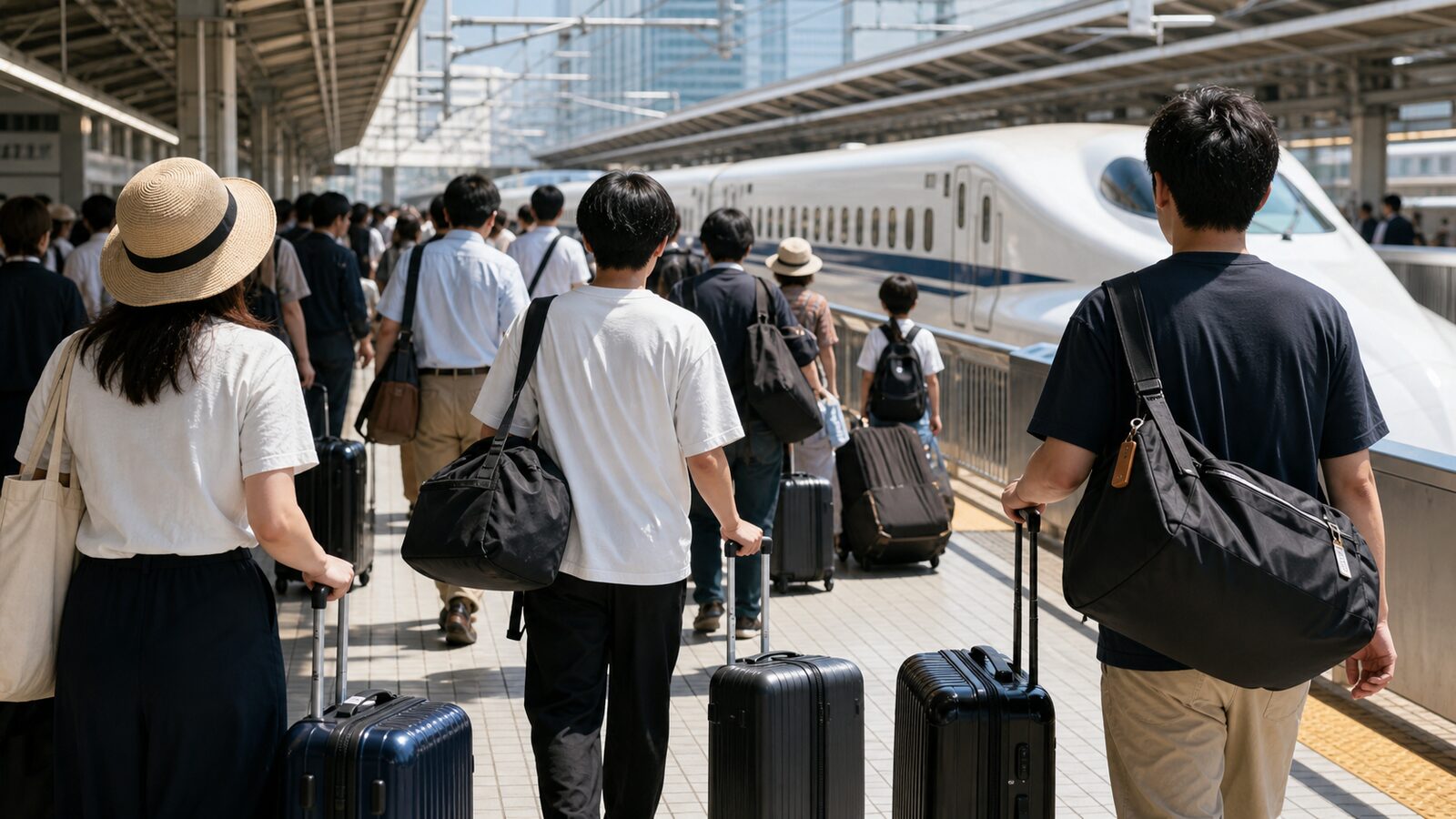
For travel planning, treat August 7–16, 2026 as the Obon peak window, not just the August 13–16 observance. The hardest train days are Saturday August 8 (leaving the cities) and Sunday August 16 (coming back), and from August 7 to 16 every Nozomi train between Tokyo and Hakata is reserved-seating only, so the usual “just grab an unreserved seat” fallback doesn’t exist. Highway traffic follows a slightly different pattern: the national NEXCO forecast highlights August 8–9 for outbound traffic and August 14 for inbound traffic.
Obon is the week when Japan goes home. Not to a resort — to a family house, to clean a grandparent’s grave, to sit in a tatami room with relatives they see once a year. Roughly the entire country tries to do this in the same ten days, which is why a week that isn’t officially a holiday quietly becomes the hardest week of the year to get a seat on a train.
If your trip overlaps with it, you don’t need to cancel anything. You need to know which two days to stay put, and to book about a month earlier than you otherwise would.
The dates that actually matter in 2026
Most guides tell you Obon is August 13–16 and leave it there. That’s correct for the observance, and misleading for travel planning. The transport operators work to a wider window:
| 2026 dates | Why it matters | |
|---|---|---|
| Obon observance | Aug 13–16 | Families gather; the cultural events happen |
| Peak travel period | Aug 7–16 | JR and NEXCO both apply peak rules across all ten days |
| Outbound rail peak | Sat Aug 8 | Cities empty out; the hardest day to leave Tokyo or Osaka by train |
| Return rail peak | Sun Aug 16 | The biggest rail return day |
| Public holiday | Tue Aug 11 (Mountain Day) | The only actual day off in the period |
That last row is the part people get wrong. Obon is not a public holiday. Banks, post offices, city halls, and most offices run a normal schedule through it. There is exactly one national holiday in the window — Mountain Day on Tuesday, August 11 — and no long weekend chain attached to it. Companies simply give staff a few discretionary days, which is why the exodus spreads out across a full week rather than concentrating on the official dates.
The practical consequence: the common advice to “avoid August 13 and 16” is not accurate for 2026. August 13 is a Thursday in the middle of the window and is comparatively survivable. August 8 and August 16 are the two days that will actually hurt.
The Shinkansen: your usual backup plan is gone
This is the single most important thing to know, and it catches even repeat visitors.
On a normal day, if a Shinkansen reserved seat is sold out, you buy an unreserved ticket, queue on the platform, and either get a seat or stand for an hour. Annoying, but it works. From August 7 to 16, that option is removed on the busiest corridor in the country: every Nozomi service between Tokyo and Hakata runs as all-reserved seating. No unreserved cars. If you don’t have a reservation, you don’t board.
Demand is already visible in the numbers. When JR East published its reservation figures on July 24, August 8 alone had roughly 123,000 seats booked, with morning and early-afternoon departures largely sold out more than two weeks ahead of the day.
What to do about it:
- Reserve as early as the system allows. JR opens reservations exactly one month before the travel date, at 10:00 a.m. Japan time. For a August 16 return, that’s 10:00 a.m. on July 16 — and for the peak days, seats genuinely move that morning.
- If you missed the window, shift your day, not your time. Moving from August 8 to August 10 does far more for you than moving from a 9 a.m. to a 3 p.m. departure on August 8.
- Kodama and Hikari services still run unreserved cars. They’re slower — Tokyo to Osaka goes from roughly 2.5 hours to closer to 4 on a Kodama — but on a day when Nozomi is a closed door, a slow train you can actually board beats a fast one you can’t.
- Consider going the other way. Most of the crush is radial: out of Tokyo and Osaka on the way there, back in on the way home. If you’re travelling into Tokyo on August 8, or out of Tokyo on August 16, you’re moving against the grain and it’s a startlingly ordinary journey.
Driving is worse than the trains
If your plan involves a rental car, take this seriously. NEXCO’s national forecast counts 436 separate traffic jams of 10 km or longer across the August 7–16 window. A jam of that length can add substantial time to a journey. Unlike the rail pattern, the highway forecast highlights August 8–9 for outbound traffic and August 14 for inbound traffic, so do not assume that August 16 is the only difficult driving day.
A three-hour drive that becomes a six-hour drive with a car full of people is a genuinely bad day. If you’re set on a road trip in August, aim it at the middle of the window — August 11 through 13 — and start early in the morning, before the day’s build-up begins.
What closes, and what doesn’t
Visitors often expect Obon to shut the country down. It doesn’t, but the closures are unevenly distributed in a way that’s easy to trip over.
Reliably open: convenience stores, major chain restaurants, department stores, supermarkets, museums and attractions in tourist areas, hotels, trains and buses (often on holiday timetables), banks and ATMs on weekdays.
Often closed: small family-run restaurants and izakaya, independent shops, local craft workshops, small clinics, and neighbourhood businesses generally — sometimes for the full four days. The rule of thumb: the smaller and more family-operated a place is, the more likely it closes, because the family is the business and the family has gone home.
If there’s a particular small restaurant or workshop you’ve built a day around, check its schedule before you commit. Many post their Obon closure dates on Instagram or a handwritten sign rather than anywhere a search engine will find.
The upside nobody mentions
Here’s the trade most visitors never hear about: while the trains and expressways are unbearable, the cities themselves get quieter. Millions of people leave Tokyo and Osaka. Commuter trains run half-empty. The lunch queue at the place that always has a lunch queue is ten minutes instead of forty. Streets that are normally shoulder-to-shoulder open up.
If you can stay put in one city across August 13–16 — no intercity travel, just walking, eating, and looking at things — Obon is one of the most pleasant weeks of the year to be in urban Japan. It’s the moving between cities that’s punishing, not the being there.
That’s the strategy that works: park yourself somewhere for the peak days, and do your long-distance legs before August 7 or after August 16.
What’s actually worth seeing during Obon
The festival itself is the reason to be here in the first place, and the biggest events fall right in the window.
- Gozan no Okuribi (Kyoto) — the ceremonial fires lit on five mountainsides around Kyoto to send ancestral spirits off at the end of Obon. Sunday, August 16, from 8:00 p.m. Enormous crowds, free to watch from anywhere with sightlines, and it falls on the single worst return-travel day of the year, so plan to stay in Kyoto that night rather than trying to get back to Tokyo afterwards.
- Bon Odori — neighbourhood dance festivals held nightly through July and August, in parks, shrine grounds, and town squares almost everywhere. Free, no booking, no skill required; the steps loop and you learn them by copying the person in front of you. We cover what these are and how to join in properly in our guide to Obon and Bon Odori.
- Toro nagashi — lantern-floating ceremonies on rivers at the close of Obon, held in many cities. Quieter and more affecting than the big festivals.
If you’re basing yourself in Kansai for the okuribi and want one structured day that doesn’t involve working out train connections during peak season, a Nara Park, Fushimi Inari & Arashiyama day tour covers three areas with a guide handling the logistics — useful in a week when trains between them are unusually full.
A workable Obon itinerary
If your dates are already fixed and they run through the window, this is the shape that causes the least pain:
| Dates | Do this |
|---|---|
| Before Aug 7 | All long-distance moves. Get to your base city. |
| Aug 7–10 | Stay local. Day trips within one region only. |
| Aug 11–13 | The calmest stretch. If you must move intercity, move now. |
| Aug 14–16 | Stay put. Bon Odori in the evenings; okuribi on the 16th if you’re in Kyoto. |
| Aug 17 onward | Travel resumes to normal. Book your long legs here. |
Flying to Japan during the summer rush? Our free four-page Japan Travel Starter Kit covers connectivity, airport transport, IC cards, cash, packing, etiquette, and the final checks worth making before departure.
If you are arriving by air during this period, use our Narita and Haneda airport-to-Tokyo guide to decide your first transfer before you land. The Obon problem is not only the intercity train; airport transfers also become harder when you are making decisions while tired and carrying luggage.
FAQ
Is Obon a public holiday in Japan? No. Only Mountain Day on August 11, 2026 is an official national holiday during the period. Banks, post offices, and government services operate normally on the other days. The travel congestion comes from companies granting discretionary leave, not from a statutory shutdown.
What are the exact 2026 Obon dates? The observance is August 13–16 in most of Japan, though Tokyo and some areas follow an older July calendar. For travel purposes the period that matters is August 7–16, which is the peak window both JR and the expressway operators are working to.
Can I use an unreserved Shinkansen seat during Obon 2026? Not on the Nozomi between Tokyo and Hakata — those services run all-reserved from August 7 to 16, with no unreserved cars at all. Kodama and Hikari services still offer unreserved seating on the same route and are the realistic fallback, at the cost of a slower journey.
How far in advance should I book Shinkansen tickets for Obon? Exactly one month ahead, when reservations open at 10:00 a.m. Japan time on the date one month before travel. For the August 8 and August 16 peaks, popular departures sell out on that first morning.
Is a Japan Rail Pass still worth it during Obon? It still covers Hikari and Kodama services and reserved seats on them, but it has never covered Nozomi, which is precisely the service under all-reserved rules in this window. The pass doesn’t get you a seat that doesn’t exist — you still need to make reservations early, pass or no pass.
Should I avoid visiting Japan during Obon entirely? No, but plan around the movement rather than the dates. Staying in one city across August 13–16 is genuinely pleasant, because the cities empty out. It’s the intercity travel on August 8 and August 16 that turns a good trip into a bad one.
Can tourists join a Bon Odori during Obon? Yes. Most Bon Odori events are free, open to visitors, and require no advance booking or dance experience. Our Obon and Bon Odori guide explains what happens around the yagura and how to join the dancing without feeling out of place.
Keep planning your Obon trip
- How to join a Bon Odori festival in Japan
- What to pack for Japan: a first-timer’s practical list
- Fushimi Inari Taisha guide for Kyoto
Official sources
- JR Central: Nozomi all-reserved seating during the 2026 Obon peak period
- JR Central: Limited express trains with all seats reserved during the 2026 Obon period
- NEXCO Central Japan: 2026 nationwide Obon traffic forecast
This site may include affiliate links, including one Kansai day tour link in this article. If you book through it, we may earn a small commission at no extra cost to you.