
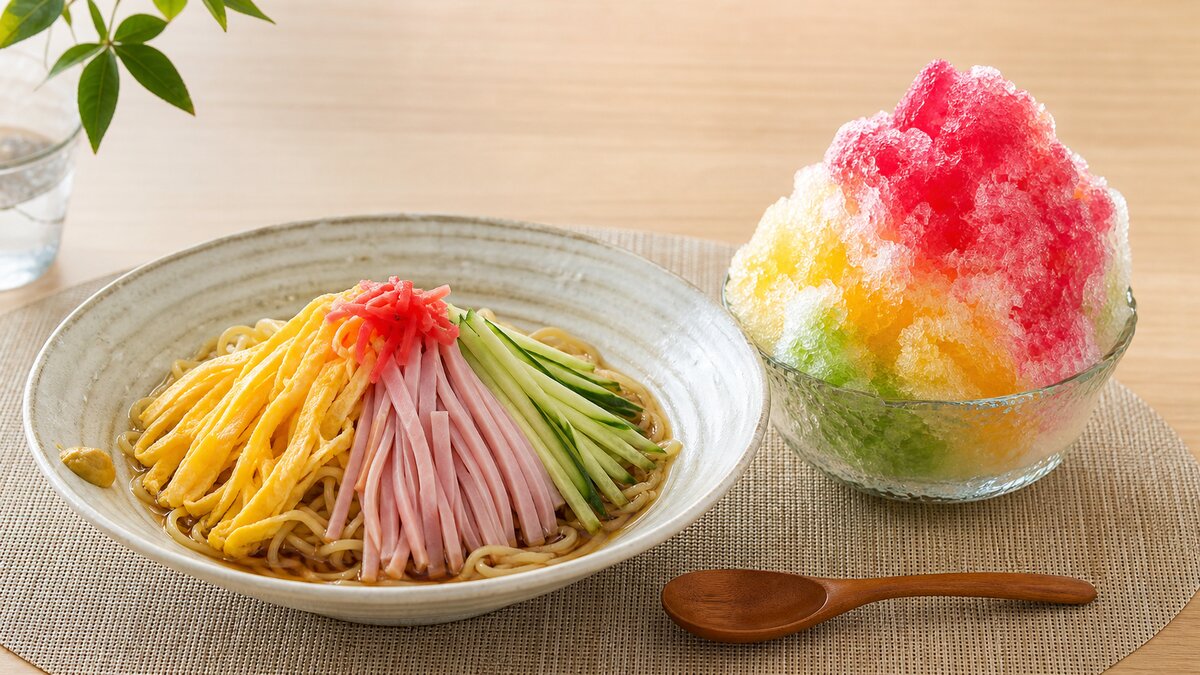
Japanese summer is hot and humid enough that entire categories of food exist just to survive it — cold noodles, shaved ice, and barley tea aren’t novelty items here, they’re the default from June through September. None of it requires reading Japanese. Here’s what each dish actually is, where you’ll find it, and how to order it without guessing.
Why “cold” isn’t just “not hot” here
Japanese summer heat is a specific kind of miserable — high humidity on top of high temperatures, with little relief even after dark in most cities. The food culture responded by building a whole seasonal menu around cooling down, not just serving cold versions of normal dishes. Restaurants that serve piping-hot ramen or udon nine months a year will quietly swap in chilled versions the moment summer starts, and it’s less a special order than the expected thing to eat.
The quick-reference table
| Dish | What it is | Where to find it | How to order |
|---|---|---|---|
| Hiyashi chuka | Chilled ramen noodles topped with thin egg strips, cucumber, ham, and a tangy sesame or soy-vinegar dressing, mixed together as you eat | Ramen shops, as a summer-only menu item (often only listed June–September) | Look for 冷やし中華 on a poster or seasonal menu insert; point at the photo if there’s no English |
| Zaru soba | Cold buckwheat noodles served on a bamboo draining tray, dipped bite by bite into a soy-dashi sauce with wasabi, ginger, and scallion | Soba shops, station stand-up counters, many teishoku (set meal) restaurants | Ask for “zaru soba” — noodles and dipping sauce are separate, don’t pour the sauce over the noodles |
| Cold somen | Very thin wheat noodles served chilled, dipped in a light men-tsuyu sauce; some restaurants serve it as nagashi somen, “flowing” down a bamboo chute | Home-style restaurants, and specialty nagashi somen spots (more common in warmer regions) | If it’s nagashi somen, watch the chute and use chopsticks to grab noodles as they pass — it’s meant to be a bit chaotic |
| Cold udon (hiyashi udon) | Thick, chewy udon noodles served chilled, often with tempura crumbs (tenkasu), a raw egg, and cold dashi broth | Udon chains and standing udon/soba counters, especially near train stations | Ask for “hiyashi udon” specifically — some shops default to hot unless you say cold |
| Kakigori | Finely shaved ice topped with syrup — classics include Uji matcha, strawberry, and melon — ranging from a quick convenience-store cup to an elaborate dessert at a specialty shop | Convenience stores and supermarkets (cheap, fast) up to dedicated kakigori shops (natural ice, condensed milk, mochi add-ins) | At a shop, just point to the flavor photo; specialty shops may have a wait in peak summer |
| Mugicha | Roasted barley tea, served cold, caffeine-free | Literally everywhere — vending machines, konbini, restaurants, most Japanese households | No ordering needed at most restaurants; it’s often the free water substitute |
| Anmitsu / warabimochi | Cold wagashi (traditional sweets): anmitsu is jelly cubes, fruit, and red bean paste in syrup; warabimochi is a jelly-like bracken-starch mochi dusted with kinako soybean flour | Traditional sweets shops, department store basements (depachika), some cafés | Ask for it by name, or point at a display case — both are commonly sold pre-plated |
Hiyashi chuka: the ramen shop’s summer switch-up
Hiyashi chuka is cold ramen noodles, but it eats nothing like a bowl of ramen — no broth, no slurping hot soup in 35°C weather. The noodles are chilled and topped with thin strips of egg, cucumber, ham, and often tomato or crab stick, then finished with a tangy sesame or soy-vinegar dressing that you mix through everything before eating. It’s closer to a composed cold noodle salad than a soup.
The catch for travelers: it’s genuinely seasonal. A shop that serves it in August may not have it on the menu at all in December, so if you’re chasing a specific dish, summer is the window. Look for a poster reading 冷やし中華 near the entrance or a laminated seasonal insert in the regular menu — that’s usually how shops signal it’s available. If you’ve already read up on how ramen ticket machines work, the same buy-a-ticket-first system usually applies here too.
Zaru soba and cold somen: the dipping-noodle family
Zaru soba is cold buckwheat noodles served on a bamboo draining tray (the zaru), with a small cup of concentrated dipping sauce on the side, usually with wasabi, grated ginger, and scallion to stir in. The technique matters: you dip a bite of noodles into the sauce rather than pouring the sauce over the noodles — treat it more like fondue than a soup.
Cold somen is the same idea with much thinner wheat noodles, and it’s the dish behind nagashi somen (“flowing noodles”), where bundles of chilled somen are sent rushing down a split-bamboo chute and diners catch them with chopsticks before dipping them in sauce. It’s more of a novelty summer activity than an everyday lunch, and it’s more commonly found at specialty restaurants or seasonal events than as a walk-in option in every city — worth seeking out if you see it advertised, but don’t expect it at a random soba counter.
Cold udon: the same shop, a different order
Hiyashi udon takes the same thick, chewy udon most travelers already know from hot bowls and serves it chilled instead, frequently topped with crunchy tempura crumbs (tenkasu) and a raw egg to mix in, alongside a cold dashi-based broth. The important part is that many udon shops default to hot unless you specify — so if you want it cold, say “hiyashi udon” rather than just naming the topping.
Kakigori: from a convenience-store cup to a full dessert experience
Kakigori is Japanese shaved ice, and the range is genuinely wide. At a convenience store or supermarket, it’s a cheap cup of finely shaved ice with a syrup poured over it — melon, strawberry, and matcha are common flavors, sold cold and ready to eat, roughly from late June through the end of August. At a dedicated kakigori specialty shop, it’s a different category of dessert entirely: shaved from blocks of natural ice for a lighter, fluffier texture, topped with things like real Uji matcha syrup, condensed milk, red bean paste, or mochi pieces, and priced accordingly higher than the convenience-store version.
Ordering is visual either way — point at a photo or a syrup flavor on display, no Japanese required. If a shop has a line out the door in the middle of summer, that’s usually a sign it’s a well-regarded specialty spot rather than a problem with the shop.
Mugicha: the drink you don’t have to ask for
Mugicha is roasted barley tea, always served cold in summer, and it’s the single most common drink in the country during hot months — vending machines, konbini shelves, restaurant tables, and most Japanese households keep a pitcher of it in the fridge from June onward. It has zero caffeine, so it works as an all-day hydration drink without the jitters or the sleep disruption a cold coffee or green tea might cause. At many restaurants, it’s simply what gets put in front of you instead of water, no ordering necessary.
If you want to recreate it after the trip, it’s sold as tea bags you can brew hot or cold — Yamasan’s organic Uji mugicha bags are a straightforward way to try it without needing to import anything.
Other cold wagashi worth knowing: anmitsu and warabimochi
Beyond kakigori, traditional Japanese sweets shops lean hard into cold options during summer. Anmitsu is cubes of kanten jelly, fruit, and sweet red bean paste served in a light syrup — refreshing rather than heavy, and commonly found in department store dessert sections (depachika) as well as dedicated wagashi shops. Warabimochi is a different texture experience: a translucent, jelly-like mochi made from bracken starch rather than rice, usually dusted with toasted kinako soybean flour and drizzled with dark sugar syrup (kuromitsu). It originated in the Kansai region and remains especially associated with Kyoto and Osaka summers. Both are usually sold pre-plated in a display case, so pointing works fine if you don’t want to attempt the names out loud.
Convenience stores are a legitimate first stop
Don’t skip the konbini for this — 7-Eleven, Lawson, and FamilyMart all rotate in cold seasonal items through summer: cups of kakigori, cold noodle sets you can eat at the in-store seating if there is any, melon soda floats, and cold mugicha or barley-tea blends by the register. None of it needs a translation app — the packaging photos do the work, and konbini staff are used to tourists pointing at the fridge case.
FAQ
Is hiyashi chuka available year-round? Usually not. It’s treated as a summer specialty, typically appearing on menus from around June and disappearing by early autumn. If you want it specifically, plan for a summer trip.
Do I need to speak Japanese to order any of this? No. Photo menus, display cases, and pointing at the item work for everything on this list — ramen shops with hiyashi chuka, soba counters, kakigori shops, and konbini fridges are all set up for customers who can’t read the labels.
Is mugicha the same as green tea? No — mugicha is made from roasted barley, not tea leaves, and has no caffeine. Green tea (ocha) is the caffeinated counterpart you’ll also see everywhere; if a restaurant serves you a cold amber-colored drink automatically, it’s very likely mugicha.
What’s the difference between convenience-store kakigori and the shop version? The convenience-store cup is fast, cheap, and made from regular shaved ice with a poured syrup. Specialty kakigori shops shave the ice from natural ice blocks for a lighter texture and use higher-quality syrups and toppings, at a noticeably higher price and often with a wait in peak summer.
This post contains affiliate links. If you buy through a link on this page, we may earn a commission at no extra cost to you. This does not affect our recommendations.