
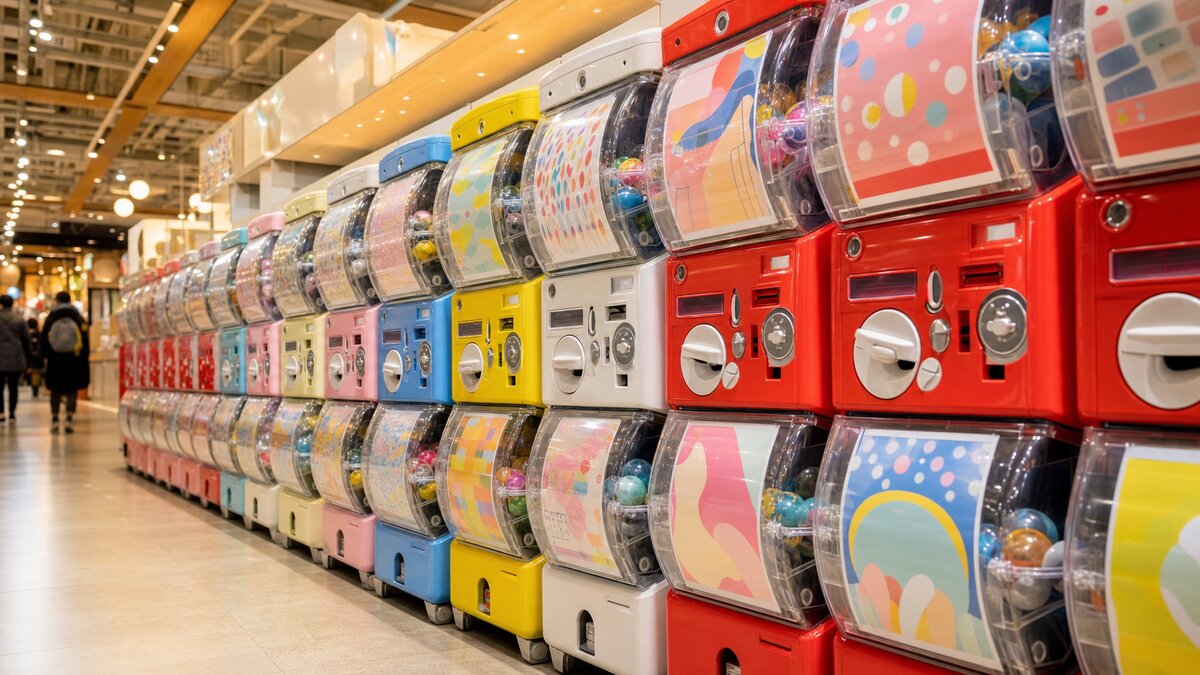
Japanese youth culture right now runs on a handful of things you’ll physically bump into as a traveler: capsule toy (gacha gacha) machines that have quietly become a billion-dollar industry, photo booths (purikura) that 86% of teenage girls still use despite smartphones, and convenience store snacks that sell out in days because of a single viral clip. None of this is retro nostalgia — it’s active, current, and mostly invisible to visitors who don’t know what they’re looking at. Here’s what’s real, what’s changed recently, and what’s just persistent background noise that’s been true for years.
The capsule toy wall you’ll see in every station
If you’ve walked through a train station, department store basement, or arcade anywhere in Japan recently, you’ve seen it: a wall — sometimes a whole floor — of gacha gacha (capsule toy) machines. This isn’t a leftover from childhood. It’s a genuinely booming industry: manufacturer shipment value grew from roughly ¥72 billion in 2022 to ¥115 billion in 2023 and about ¥141 billion in 2024, according to reporting by Toyo Keizai, one of Japan’s major business publications. Industry commentary has started calling it the “fifth boom” in the toy’s decades-long history.
What’s changed is where the machines live and who’s buying. Dedicated capsule toy specialty stores — entire storefronts of nothing but gacha machines — have spread into department stores and station concourses that used to house other retailers. And the audience has widened well past kids: younger children go for franchises like Pokémon, teens gravitate toward whatever anime or manga is currently popular, and adults buy miniatures, retro-style novelty items, and character goods tied to their own fandoms (oshi-katsu, or “supporting your favorite” culture, spans idols, anime characters, and virtual streamers alike). It’s common to see toy lines specifically built as small acrylic charms or keychains meant to be filled with a photo — a purikura strip, a selfie, a favorite shot — which is a direct product of gacha and purikura culture feeding into each other.
What this means for you: the machines are genuinely everywhere (Akihabara has entire dedicated floors, but so does almost any mid-size station), they typically run ¥200–¥500 per capsule, and browsing them — even without buying — is a completely normal way locals spend ten minutes killing time. If you’re already planning an Akihabara stop for merch shopping, our anime pilgrimage guide covers how to navigate the collectibles scene there.
Purikura: still everywhere, quietly reinventing itself
Purikura — photo booths that print out sticker-sheet photos, usually with heavy digital retouching — have been a fixture of Japanese youth culture since the 1990s, and it would be easy to assume smartphones killed them. They didn’t. Toyo Keizai’s reporting on the format’s 30th anniversary found that while the market has shrunk to roughly a fifth of its peak size (the format once did close to ¥100 billion a year), an estimated 86% of “Reiwa-era” teenage girls still use purikura regularly. The reason, per that same reporting, is that purikura still does things a phone camera can’t easily replicate — a specific kind of stylized, “mood”-driven retouching and a physical printed object you can carry.
What has genuinely shifted recently is the style of retouching. Multiple Japanese youth-media sources (including Popteen, a long-running magazine aimed at teenage girls) describe a move away from heavy, face-altering “look like a different person” editing toward softer, more natural results that preserve the actual mood of the moment. A parallel trend sometimes labeled “Korean purikura” — minimal digital retouching, closer to an unfiltered selfie, prioritizing candid mood over transformation — has picked up among younger users. Printed strips are commonly slipped into the back of a clear phone case rather than kept in an album, which is its own small, easy-to-spot signal of youth culture in the wild.
You’ll find purikura booths clustered inside game center chains — GiGO (Sega’s arcade brand) is the most visible, with dedicated purikura floors in locations like Ikebukuro and Akihabara, alongside chains like Round1 and Taito Station. A session runs roughly ¥400–¥500, is cash-based at most machines, and takes about five minutes including the retouching and layout steps. It’s a genuinely fun, low-stakes thing to try even if you feel too old for it — nobody at the machines is checking IDs.
Konbini snacks: the fastest-moving trend cycle in the country
Convenience stores (konbini) run one of the most aggressive limited-edition product cycles anywhere in retail, and it’s a good barometer of what’s currently trending with younger consumers because turnaround is so fast — a snack can go from a viral clip to a store shelf in weeks, then disappear again. This is a durable pattern, not a one-off: seasonal and collaboration snacks have driven konbini traffic for years, and Japanese trend-tracking coverage consistently shows spikes in “limited edition” search interest around key seasonal windows.
A concrete recent example: “Dubai chocolate” — a thick chocolate bar filled with pistachio cream and crispy kataifi pastry, popularized globally through ASMR-style unboxing videos — became a genuine convenience store phenomenon in Japan through 2025, with FamilyMart and 7-Eleven both running their own limited versions (an ice cream bar and a mochi adaptation, respectively) once the format’s crunch sound had already gone viral on social video. The specific product will be old news by the time you read this — that’s the point. The mechanism (a social-video trend translating into a limited-run konbini product within weeks) is the actual, durable thing to understand, and it repeats constantly enough that “what’s the current seasonal snack” is a genuinely reasonable thing to ask a Japanese friend or hotel staff if you want a real-time answer. For the basics of navigating konbini as a first-time visitor, see our konbini culture guide.
Is Harajuku still the center of youth fashion?
Given how much has changed in youth culture over the past decade, it’s fair to wonder whether Harajuku and Takeshita Street are still relevant to actual Japanese teenagers or have become a tourist-only relic. The honest answer, based on current coverage, is that it’s both — and that’s not new. Takeshita Street has been a curated, commercially dense youth fashion strip since the late 1970s, and it continues to function as an active retail center rather than a museum piece: Tokyu Land Corporation opened Harakado, a new commercial complex at the Harajuku/Jingumae intersection, in April 2024, explicitly positioned as a new hub for youth culture and creative retail — a real, verifiable, recent development, not projected nostalgia.
Fashion trade press (FASHIONSNAP, one of Japan’s established fashion industry outlets) has also reported a strong and ongoing wave of Korean fashion and food influence on Takeshita Street through 2025, describing it as part of a broader “third Korean wave” affecting cosmetics and food alongside clothing. So the specific stores and styles keep turning over — that’s normal for any youth fashion district — but the underlying pattern (Harajuku as Tokyo’s most concentrated, fastest-changing youth retail zone) has held for decades and shows no clear sign of stopping.
How students actually communicate
This one’s a durable, well-established pattern rather than a fast-moving trend: LINE is Japan’s dominant messaging app across essentially every age group, and it’s the one app you’ll see used for everything from group chats to store loyalty programs to splitting a restaurant bill. If you’re traveling with or meeting Japanese students, LINE — not WhatsApp, not iMessage — is how they’ll actually want to stay in touch. On top of that base layer, government survey data (Japan’s Ministry of Internal Affairs and Communications) has shown TikTok usage concentrated most heavily among teenagers of any age group, though exact percentages vary meaningfully between surveys and shift quickly — treat any specific number here as a snapshot, not a fixed fact.
FAQ: Japanese youth culture for travelers
Are capsule toy (gacha gacha) machines worth trying as a tourist? Yes — they’re cheap (typically ¥200–¥500), require no Japanese language ability, and are a completely normal thing for adults to do, not just kids. Akihabara and major train stations have the widest selection.
Can tourists use purikura booths, or is it awkward for non-Japanese visitors? Tourists use them regularly and staff are used to it. The menus are visual and icon-driven enough to navigate without reading Japanese, though having a Japanese friend or a translation app handy for the customization screen helps. Bring cash — most machines don’t take cards.
Is Harajuku/Takeshita Street still worth visiting, or has it become purely a tourist trap? It’s genuinely still an active youth fashion and culture district for Japanese teens, not just a preserved tourist attraction — recent developments like the Harakado complex (opened 2024) were built specifically to serve that local audience. Expect it to be crowded with both tourists and locals; that mix is part of what it’s always been.
What’s the best way to see “real” current trends instead of outdated ones? Konbini snack shelves and gacha machine selections turn over fastest and are a genuinely live read on what’s currently popular, since both formats depend on rapid restocking. If something’s still stocked when you’re there, it’s current by definition.
Sources for the figures and claims above include Toyo Keizai, FASHIONSNAP, Popteen, and Tokyu Land Corporation’s official press materials — all verified independently rather than taken from secondary trend-roundup sites.